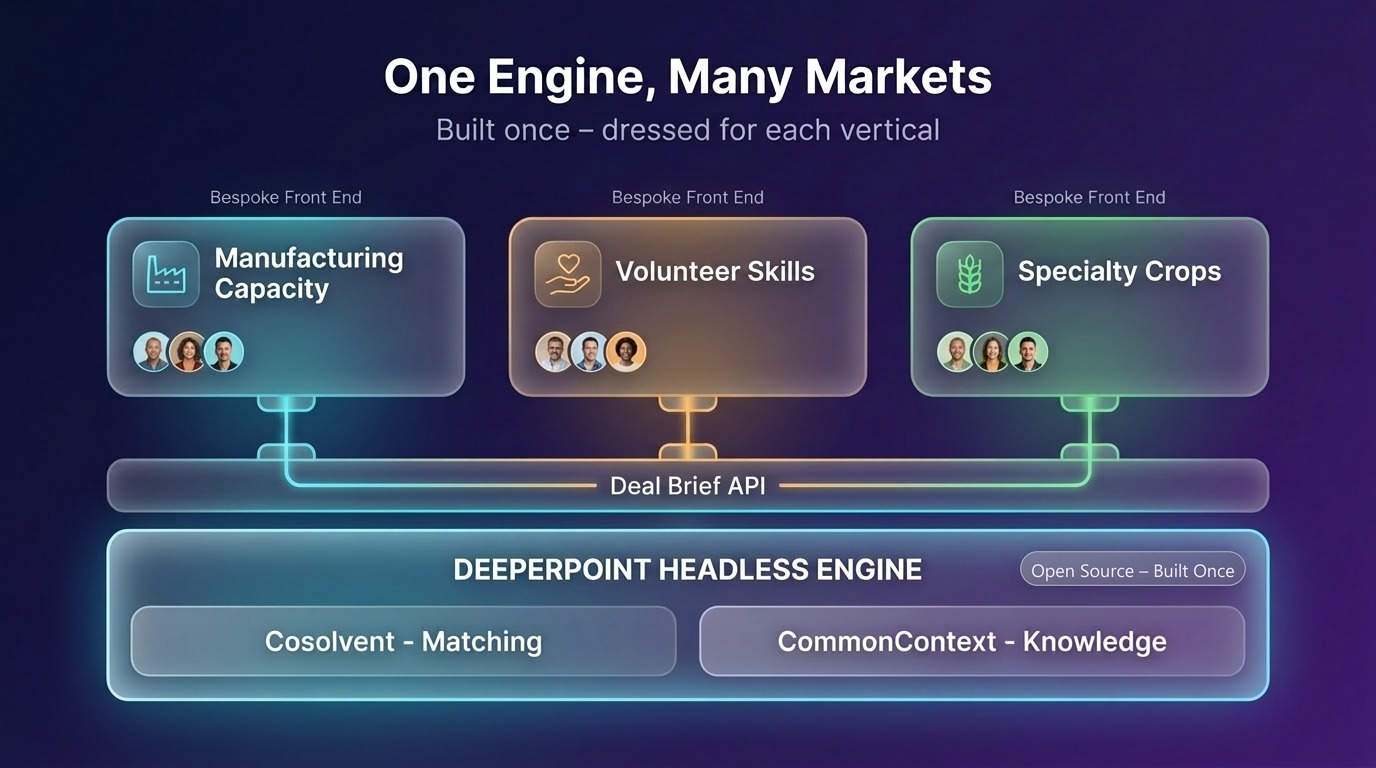
DeeperPoint applies the six AI interventions in a generic, open-source marketplace engine — not tied to any vertical. A market sponsor adopts it, adds their market’s business logic, and skips a decade of rediscovering the same problems.
The DeeperPoint thesis: because the frictions that keep markets thin are common across thousands of markets, the friction-fighting layer can be built once and open-sourced. A sponsor reuses it and adds only their market’s business logic — instead of rediscovering the same problems alone.
DeeperPoint offers the solution — Cosolvent (the matching engine) plus CommonContext (the curated knowledge layer) — as free, MIT-licensed, headless server functionality. It is deliberately not a shrink-wrap product for any market vertical, and probably can't become one: everything vertical-specific is exactly what the adopter must own.
Headless semantic matching engine — multi-attribute similarity, privacy-aware profiles, match-story generation.
Curated vertical knowledge: regulations, certifications, rates — the context that grounds matches in reality.
The step-by-step path a sponsor follows to stand up a vertical on the engine. Creation Guide PDF available.
The system runs the six interventions as one continuous flow, from raw inputs to a deal that is ready to hand off:
Most marketplace platforms aim to close deals. DeeperPoint aims to get deals ready to close. The platform’s primary output is the Deal Brief — a structured, non-binding summary of everything two parties have explored and agreed. It captures who the parties are, what they propose to exchange, what remains open, and which professional intermediaries need to act next.
The Deal Brief is not a contract and is never intended to become one. It is the compilation of deal notes that all parties hand to their attorneys, bankers, insurers, and freight carriers — to speed the production of the real, authoritative agreement documents.
That is where DeeperPoint's deal-making function is complete. The Deal Brief is as far as friction reduction can go while staying generic — the last step common to every market. Everything after it — contracts, payments, fulfillment, analytics, advertising, fee-for-service — lies within each adopting sponsor’s span of control and beyond DeeperPoint’s purview.
The owner of a market vertical adopts the DeeperPoint suite and builds a market-specific front end on top of it: branding, participant UX, legal templates, payment rails, sponsorship services. With modern AI coding tools — Claude Code goes a long way — an adopter can produce a working digital twin of their market, and perhaps even a modest working marketplace site, in a fraction of the traditional effort.
While Cosolvent and CommonContext are open source, testing a new thin market requires realistic participants — which, by definition, a new market doesn't have yet. ClientSynth is DeeperPoint's simulation tool: it populates a Cosolvent instance with synthetic, agentic buyers and sellers whose profiles occupy the same schema positions as real ones, so the matching engine is exercised exactly as it will run live.
This does two jobs. First, it lets a sponsor prove the market physics work — that the engine produces quality matches for their vertical — before risking real participants' capital or reputation. Second, it can help with the ubiquitous cold-start problem: every new marketplace needs buyers to attract sellers and sellers to attract buyers. A synthetic population on one side gives early real participants something credible to react to — a working demonstration instead of an empty room — until genuine liquidity takes over. Synthetic participants are always strictly segregated from real ones.
ClientSynth details →