Thick Markets, Thin Markets
A thick market is one where buyers and sellers find each other easily, deals happen at fair prices, transactions are quick, and everyone has confidence in the outcome. The New York Stock Exchange is a thick market. So is Amazon for everyday consumer goods. Thick markets run smoothly because their trade items are standardized in the ways that matter, so conventional software can automate them.
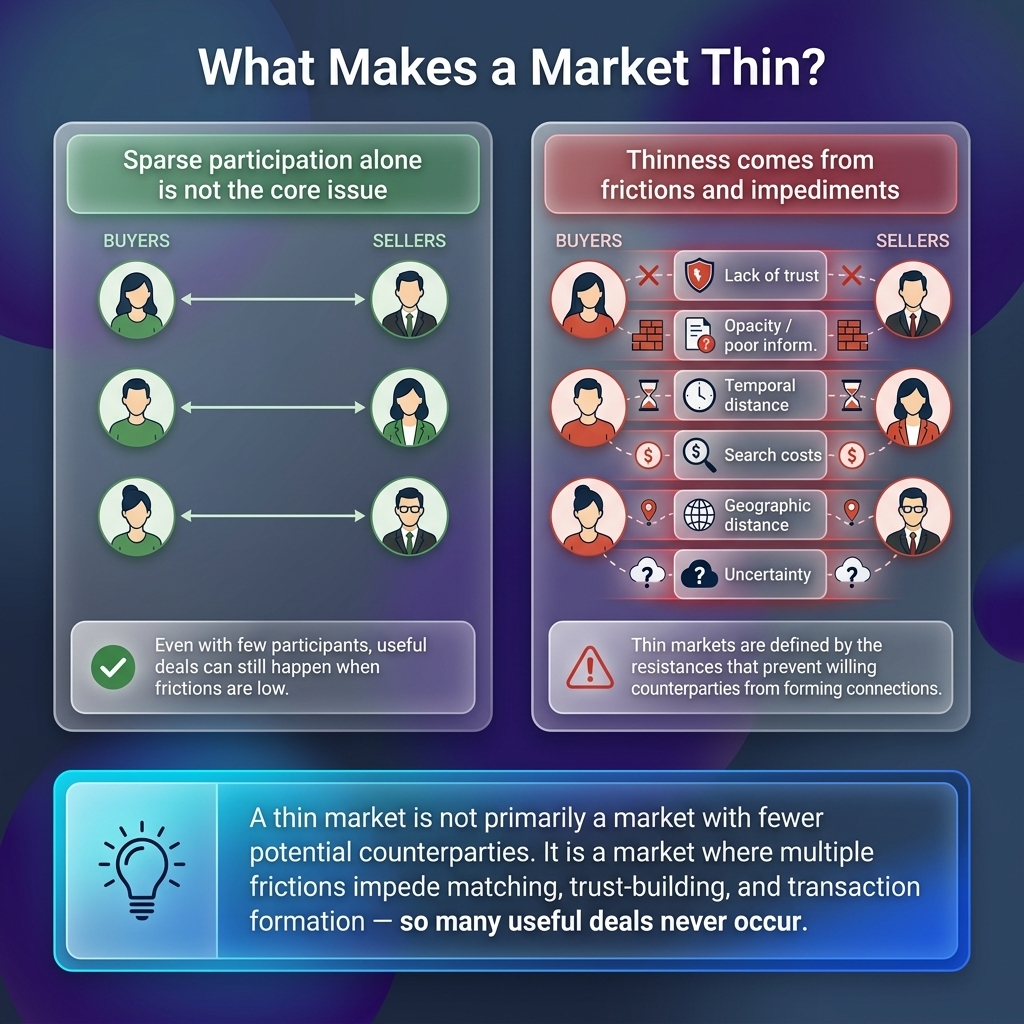
A thin market is the opposite. Transactions are infrequent. Finding the right counterparty takes months. Prices are opaque. Beneficial exchanges fail to happen — not because willing participants don't exist, but because the friction of transacting exceeds the perceived gains.
Think of the market for specialized industrial equipment, niche agricultural commodities, cross-border professional services, or rare technical expertise. These markets often have willing buyers and willing sellers — they just can't find each other reliably. Some deals are so obstructed that no one even tries. Others limp along only because human brokers, traders, and salespeople will invest the effort if the deal is big enough.
Eighty Years of Evidence
These frictions are not arbitrary. Over eighty years of economic research — recognized by Nobel Prizes across multiple decades — has mapped the forces that prevent markets from behaving freely and efficiently. The table below distills that research into a single view: the finding, the friction it explains, the traditional workaround, and the AI intervention that now covers it.
| The Finding (Scholar, Year) | The Friction It Explains | Traditional Workaround (Cost) | AI Intervention That Covers It |
|---|---|---|---|
| Transaction costs make markets expensive (Coase*, 1937) | Opacity; Fulfillment | Internalize into firms (forgo the market) | AI Matching; AI-Enabled Aggregation |
| Bounded rationality prevents optimal choice (Simon*, 1955) | Cognitive Bandwidth | Satisfice; simplify options (lose relevance) | AI Input Translation; AI Matching |
| Information is costly to acquire (Stigler*, 1961) | Opacity | Invest in search; accept price dispersion | AI Matching |
| Unobservable quality drives out good sellers (Akerlof*, 1970) | Trust; Risk | Costly certification | AI Trusted Intermediary; AI Memory |
| Credible signals require costly investment (Spence*, 1973) | Trust | Accept signaling costs as necessary waste | AI Trusted Intermediary |
| Asset specificity creates hold-up risk (Williamson*, 1975/85) | Risk; Offering Complexity | Vertical integration; long-term contracts | AI Trusted Intermediary; AI Risk Insulation |
| Commons need governance beyond markets (Ostrom*, 1990) | Participant Fragmentation | Cooperatives, marketing boards (slow, heavy) | AI-Enabled Aggregation |
| Markets require active engineering (Roth*, 2002) | Cold Start; Temporal Distance | Matching algorithms for standardized cases | AI Memory (synthetic bootstrapping); AI Matching |
| Two-sided platforms face chicken-and-egg (Rochet & Tirole*, 2003) | Cold Start | Subsidize one side (burn capital) | AI Memory (synthetic bootstrapping) |
Taken together, these models explain why so many seemingly desirable exchanges never occur: the accumulated weight of the frictions makes success so unlikely that no one bothers to try — or even think about it.
Commerce fought back over the centuries — standardization to make goods comparable, human brokers to bridge information gaps, insurance to absorb risk, escrows to enforce trust, contracts to manage hold-up. These mechanisms have worked, to a degree; entire industries exist to lubricate transactions that would otherwise never happen. But they are expensive, slow, and limited in reach. They scale poorly across borders, languages, and regulatory regimes.
That is why estimates of unrealized markets hover around $5 to $10 trillion annually on a global basis. An immense amount of productive exchange is cut off before it can even be attempted.
How Markets Get Built Today
Faced with a thin market, the usual move is to pick a product or service and build a web platform to host the exchange. Then the real work begins: the frictions above surface one at a time, and the founder solves each as it appears — a verification step here, a brokered introduction there, a workaround for opaque pricing — discovering each problem only after hitting it.
Every new market is treated as a brand-new problem. The builder sees it through the lens of their own buyers, sellers, and product, so the underlying pattern stays invisible. They may erase enough friction to succeed, or they may not — and either way, they make the journey alone.
Multiply that by thousands of thin markets and you get thousands of builders independently reinventing the same wheels — never realizing that the frictions they fight are the same handful that Coase, Akerlof, Spence, and the other scholars above named decades ago.
The Six AI Interventions
For centuries, market design was trapped in a binary choice: standardize (which aggregates volume but destroys the unique details of a trade) or preserve uniqueness (which keeps relevance but fragments the market into tiny, unmatchable pieces). AI dissolves this historic tradeoff: rather than forcing goods, services, or capacities to be identical, it interprets and mediates the natural complexity of the transaction.
DeeperPoint has identified six AI interventions that collectively address most of the known and documented market frictions:
1. AI Matching
Semantic matching of buyer intent against complex, heterogeneous supply — connecting highly specific, non-standardized needs to counterparties without forcing them into generic categories. Surfaced to participants as a Content Match Story — a case for the pairing, not just a notification. Covers: Opacity, Offering Complexity, Cognitive Bandwidth.
2. AI Trusted Intermediary
Learns sensitive information from both sides — designs, capacity, pricing flexibility — without mutual disclosure, and facilitates introductions only when compatibility is established — the mechanism that lets the match story argue from private data without revealing it. Covers: Trust, Risk, Opacity (strategic withholding).
3. AI Input Translation
Turns raw, unstructured human inputs — voice descriptions, documents, photos, any language — into structured, queryable market data, collapsing the effort of participating. Covers: Cognitive Bandwidth, participation barriers.
4. AI Memory & Active Sourcing
Maintains active, persistent representations of participants 24/7 — bridging time gaps, pushing matches when schedules align, and enabling synthetic bootstrapping of new markets. Covers: Temporal Distance, Cold Start, Trust.
5. AI-Enabled Aggregation
Dynamically pools fragmented inventories or capacities from many small providers into a single cohesive supplier that meets large buyers' volume thresholds — ad hoc, without permanent structures. Covers: Participant Fragmentation, Fulfillment.
6. AI Risk Insulation
Dynamic hedging, escape clauses, and margin insulation against external shocks — tariffs, sanctions, FX swings — that would otherwise freeze deal intent. Covers: Risk, Regulatory Friction, external market uncertainty.
Where the Interventions Become Visible: the Content Match Story
The six interventions are capabilities — and participants never see a capability. What they see is a document. When the engine finds a promising pairing, it composes a Content Match Story: an anonymous, AI-authored case for why these two parties fit and what they could accomplish together — written from private data (Trusted Intermediary) without disclosing it, grounded in both parties’ actual situations (Matching, Input Translation), and maintained continuously as the deal advances (Memory).
The story is also the answer to a friction no traditional workaround ever solved: most deals die not between the two visible parties but inside their organizations, where a skeptical approver’s cheapest move is to withhold assent. A forwardable, evidence-weighted case arms the deal’s champion to win that room.
As the parties confirm and correct successive versions, the story matures — step by step — into the Deal Brief, the platform’s final deliverable. One document, from first anonymous introduction to professional handoff. See how it works, stage by stage →
The DeeperPoint thesis: because these frictions are common across thousands of markets, the response can be built once and reused — a builder adds only their market’s business logic, instead of rediscovering the same problems alone. DeeperPoint applies this reasoning to itself: adopting a market engine is a thin-market transaction, so the toolkit is free, MIT-licensed open source — engineered to carry as little friction as possible.
Open the full Intervention Matrix
Every challenge × every intervention, cell by cell — the interactive reference version of the table above, covering both traditional and AI-powered responses.
Read the full whitepaper
A comprehensive treatment of market physics, engineering interventions, and the AI revolution in market design. With case studies and a glossary of key terms.
Browse the catalog of examples
Hundreds of searchable thin market scenarios — each analyzed through the DeeperPoint framework with market forces, sponsor opportunities, and narrative match stories.
Download the full whitepaper
The complete Market Theory whitepaper as a PDF — market physics, engineering interventions, AI capabilities, and the strategic implications for global trade.