deeperpoint.com·Why markets don’t form·Intervention matrix Deck (.pptx)

Thin-Market Resistances

15 reasons a market stays thin, one per card. Each card shows what the resistance looks like in a real market, how an AI intervention works on it, and how traditional markets have always coped. The exhaustive crossing of every challenge with every intervention is the intervention matrix.

← → keys move between cards
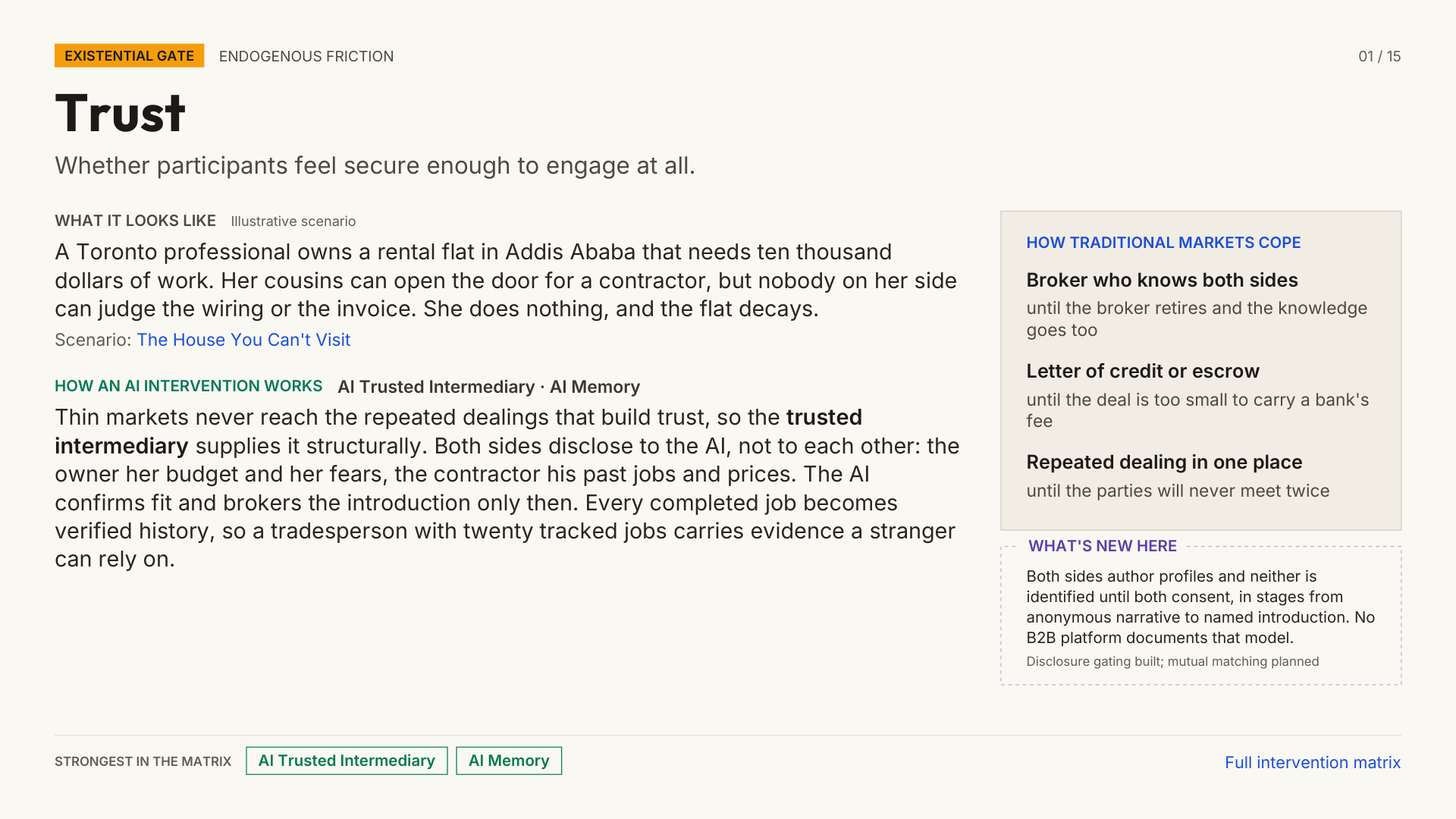
01Trust Open cardPNG
Existential gate Endogenous friction 01 / 15

Trust

Whether participants feel secure enough to engage at all.

What it looks like Illustrative scenario

A Toronto professional owns a rental flat in Addis Ababa that needs ten thousand dollars of work. Her cousins can open the door for a contractor, but nobody on her side can judge the wiring or the invoice. She does nothing, and the flat decays.

How an AI intervention works AI Trusted Intermediary · AI Memory

Thin markets never reach the repeated dealings that build trust, so the trusted intermediary supplies it structurally. Both sides disclose to the AI, not to each other: the owner her budget and her fears, the contractor his past jobs and prices. The AI confirms fit and brokers the introduction only then. Every completed job becomes verified history, so a tradesperson with twenty tracked jobs carries evidence a stranger can rely on.
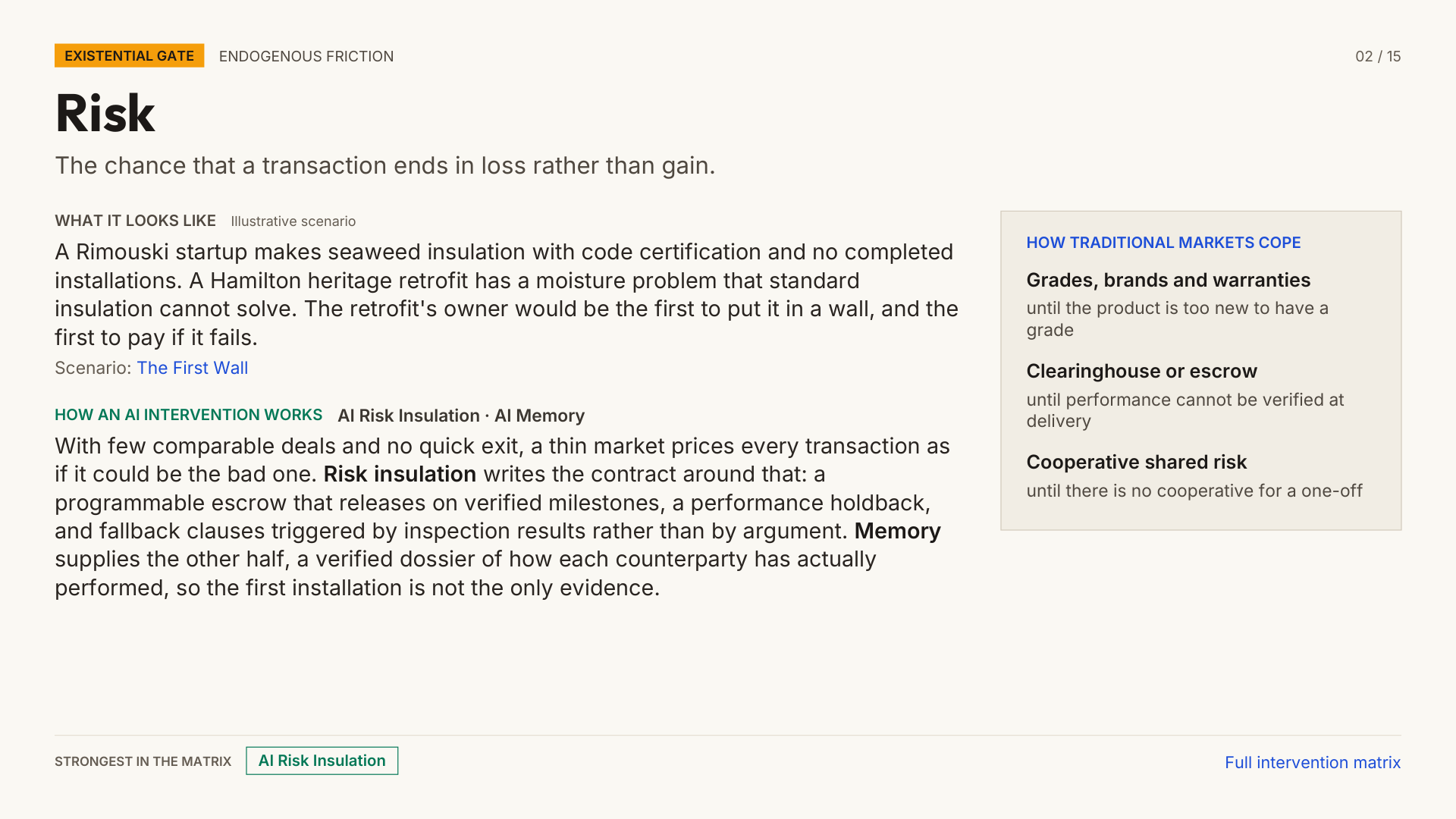
Existential gate Endogenous friction 02 / 15

Risk

The chance that a transaction ends in loss rather than gain.

What it looks like Illustrative scenario

A Rimouski startup makes seaweed insulation with code certification and no completed installations. A Hamilton heritage retrofit has a moisture problem that standard insulation cannot solve. The retrofit's owner would be the first to put it in a wall, and the first to pay if it fails.

How an AI intervention works AI Risk Insulation · AI Memory

With few comparable deals and no quick exit, a thin market prices every transaction as if it could be the bad one. Risk insulation writes the contract around that: a programmable escrow that releases on verified milestones, a performance holdback, and fallback clauses triggered by inspection results rather than by argument. Memory supplies the other half, a verified dossier of how each counterparty has actually performed, so the first installation is not the only evidence.

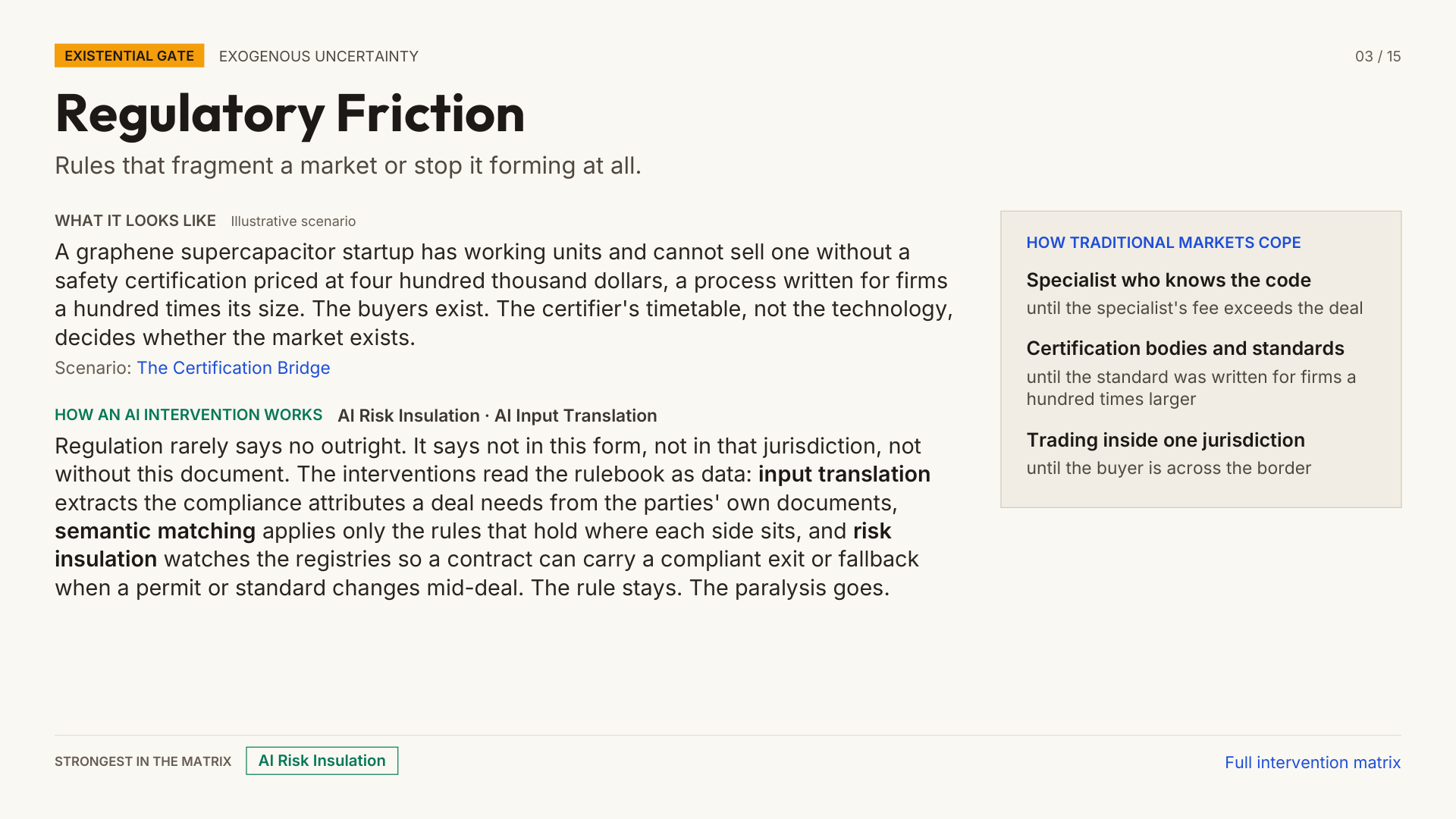
03Regulatory Friction Open cardPNG
Existential gate Exogenous uncertainty 03 / 15

Regulatory Friction

Rules that fragment a market or stop it forming at all.

What it looks like Illustrative scenario

A graphene supercapacitor startup has working units and cannot sell one without a safety certification priced at four hundred thousand dollars, a process written for firms a hundred times its size. The buyers exist. The certifier's timetable, not the technology, decides whether the market exists.

How an AI intervention works AI Risk Insulation · AI Input Translation

Regulation rarely says no outright. It says not in this form, not in that jurisdiction, not without this document. The interventions read the rulebook as data: input translation extracts the compliance attributes a deal needs from the parties' own documents, semantic matching applies only the rules that hold where each side sits, and risk insulation watches the registries so a contract can carry a compliant exit or fallback when a permit or standard changes mid-deal. The rule stays. The paralysis goes.

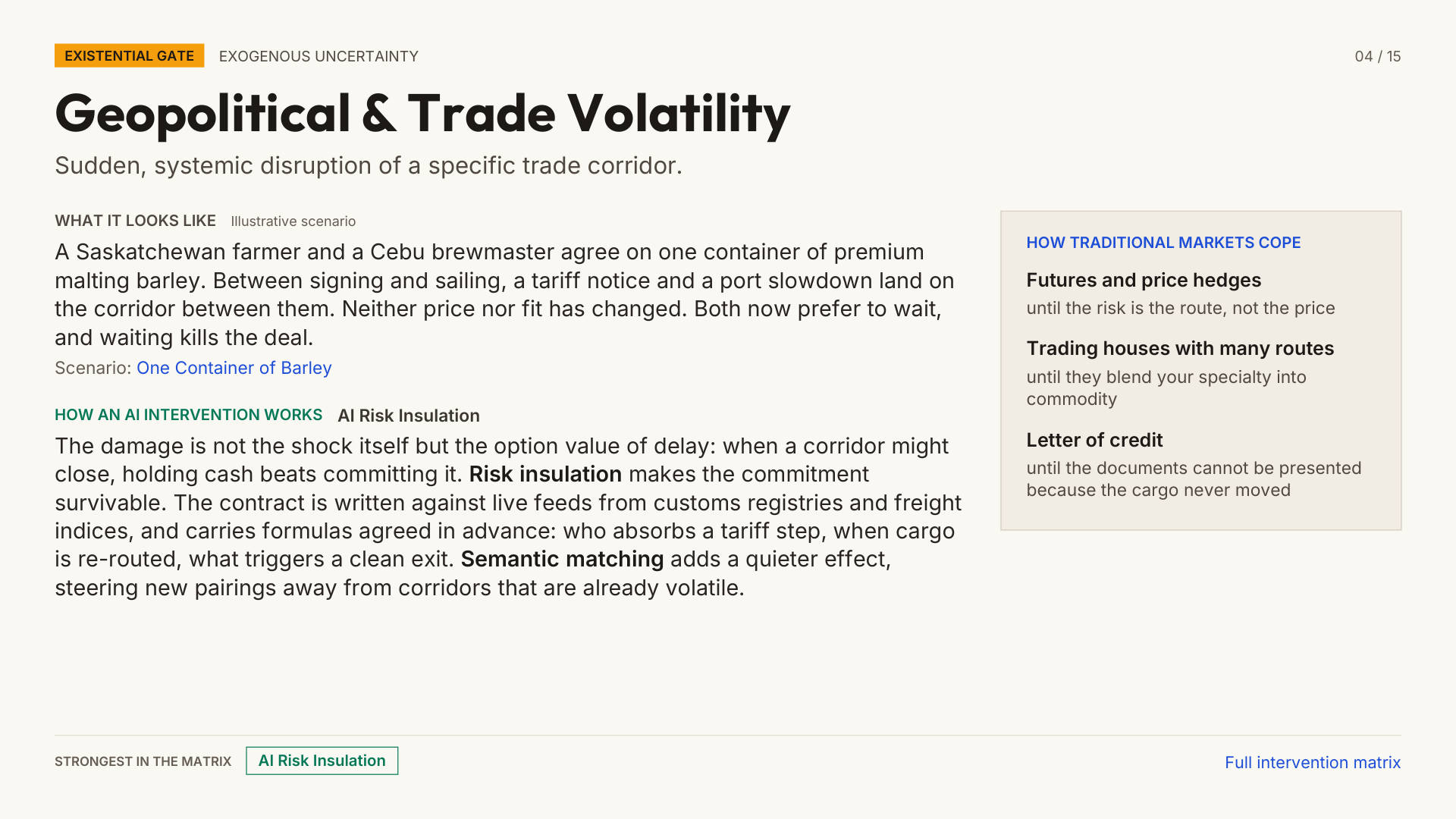
04Geopolitical & Trade Volatility Open cardPNG
Existential gate Exogenous uncertainty 04 / 15

Geopolitical & Trade Volatility

Sudden, systemic disruption of a specific trade corridor.

What it looks like Illustrative scenario

A Saskatchewan farmer and a Cebu brewmaster agree on one container of premium malting barley. Between signing and sailing, a tariff notice and a port slowdown land on the corridor between them. Neither price nor fit has changed. Both now prefer to wait, and waiting kills the deal.

How an AI intervention works AI Risk Insulation

The damage is not the shock itself but the option value of delay: when a corridor might close, holding cash beats committing it. Risk insulation makes the commitment survivable. The contract is written against live feeds from customs registries and freight indices, and carries formulas agreed in advance: who absorbs a tariff step, when cargo is re-routed, what triggers a clean exit. Semantic matching adds a quieter effect, steering new pairings away from corridors that are already volatile.

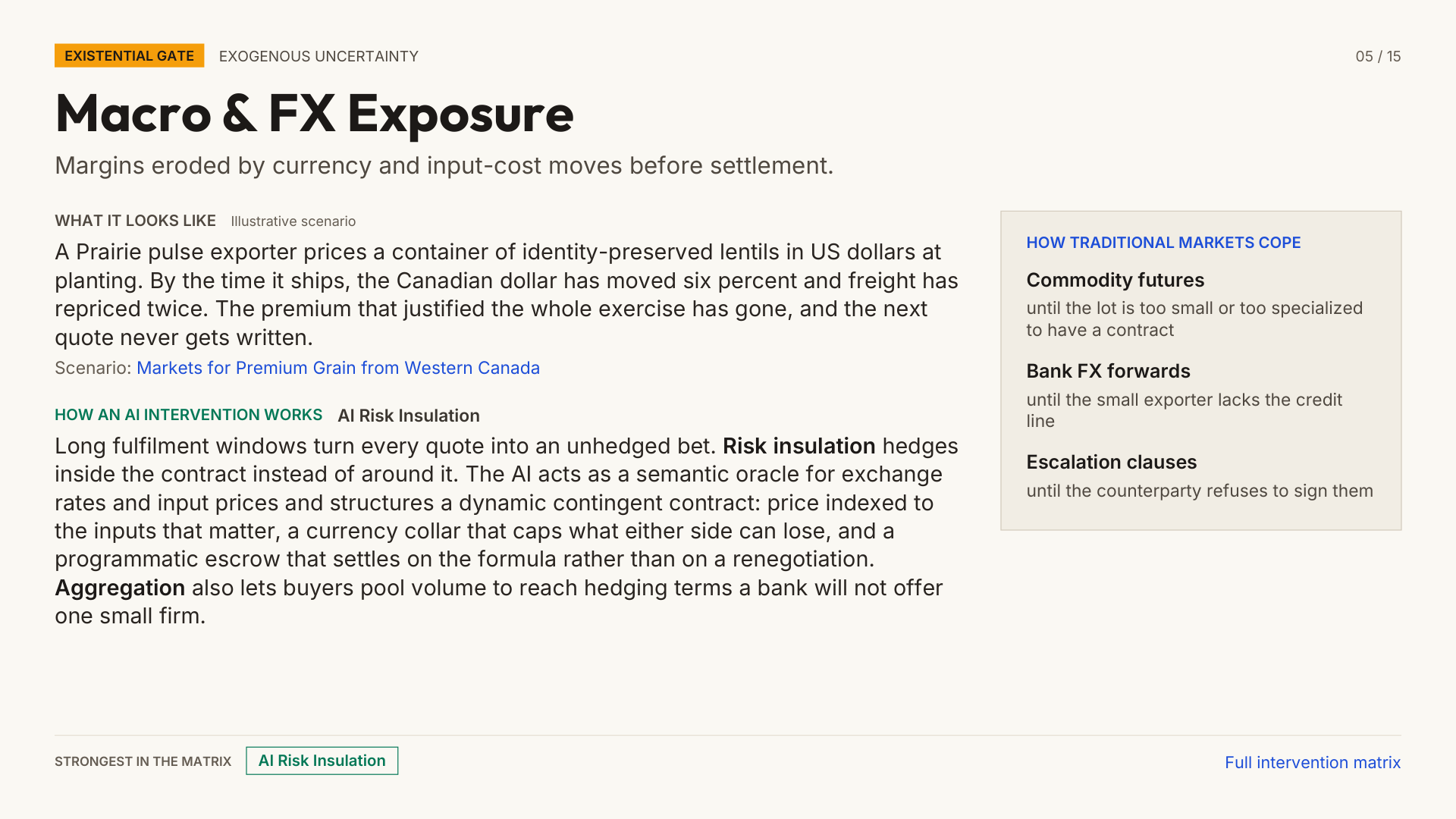
05Macro & FX Exposure Open cardPNG
Existential gate Exogenous uncertainty 05 / 15

Macro & FX Exposure

Margins eroded by currency and input-cost moves before settlement.

What it looks like Illustrative scenario

A Prairie pulse exporter prices a container of identity-preserved lentils in US dollars at planting. By the time it ships, the Canadian dollar has moved six percent and freight has repriced twice. The premium that justified the whole exercise has gone, and the next quote never gets written.

How an AI intervention works AI Risk Insulation

Long fulfilment windows turn every quote into an unhedged bet. Risk insulation hedges inside the contract instead of around it. The AI acts as a semantic oracle for exchange rates and input prices and structures a dynamic contingent contract: price indexed to the inputs that matter, a currency collar that caps what either side can lose, and a programmatic escrow that settles on the formula rather than on a renegotiation. Aggregation also lets buyers pool volume to reach hedging terms a bank will not offer one small firm.

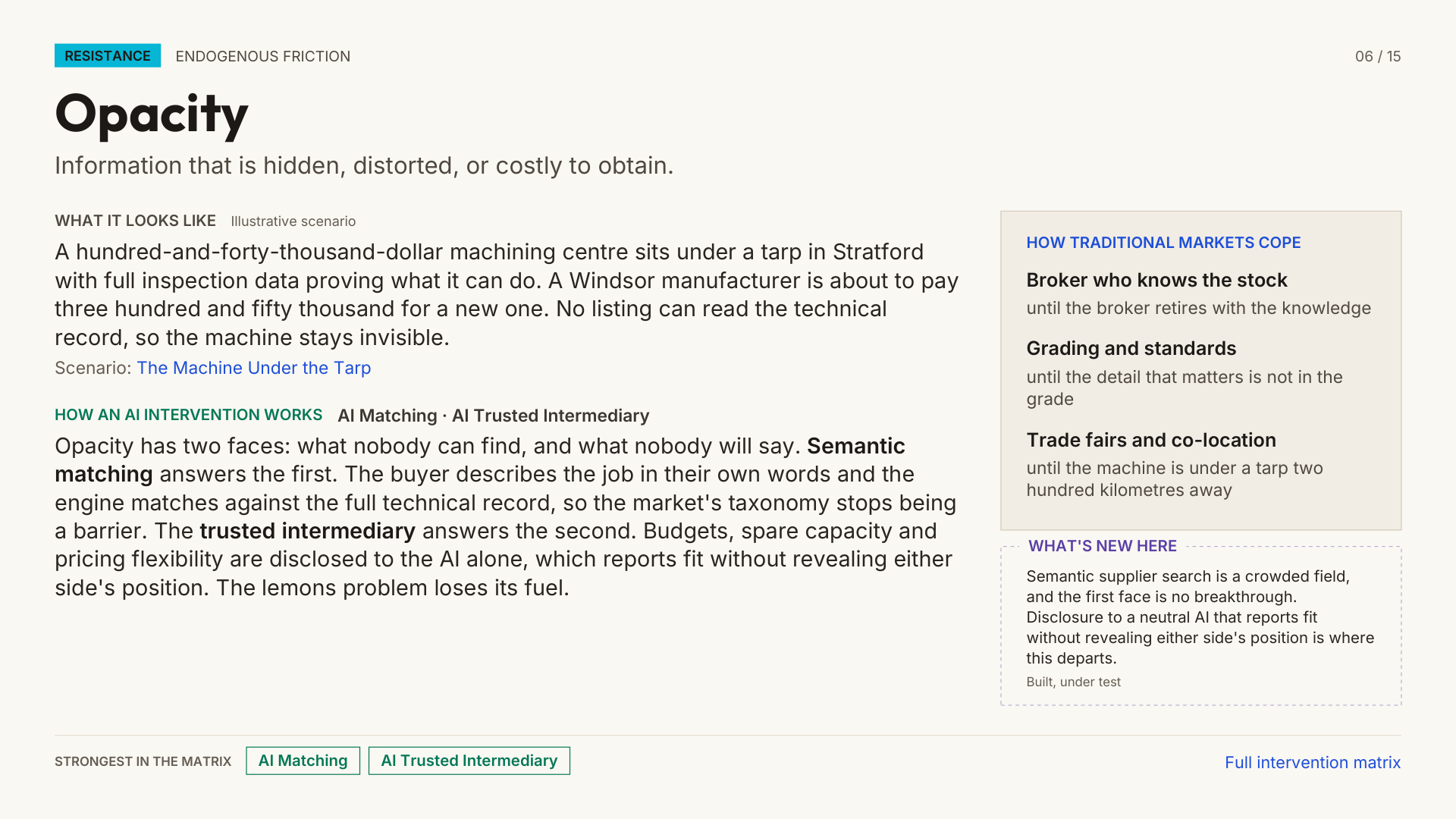
06Opacity Open cardPNG
Resistance Endogenous friction 06 / 15

Opacity

Information that is hidden, distorted, or costly to obtain.

What it looks like Illustrative scenario

A hundred-and-forty-thousand-dollar machining centre sits under a tarp in Stratford with full inspection data proving what it can do. A Windsor manufacturer is about to pay three hundred and fifty thousand for a new one. No listing can read the technical record, so the machine stays invisible.

How an AI intervention works AI Matching · AI Trusted Intermediary

Opacity has two faces: what nobody can find, and what nobody will say. Semantic matching answers the first. The buyer describes the job in their own words and the engine matches against the full technical record, so the market's taxonomy stops being a barrier. The trusted intermediary answers the second. Budgets, spare capacity and pricing flexibility are disclosed to the AI alone, which reports fit without revealing either side's position. The lemons problem loses its fuel.

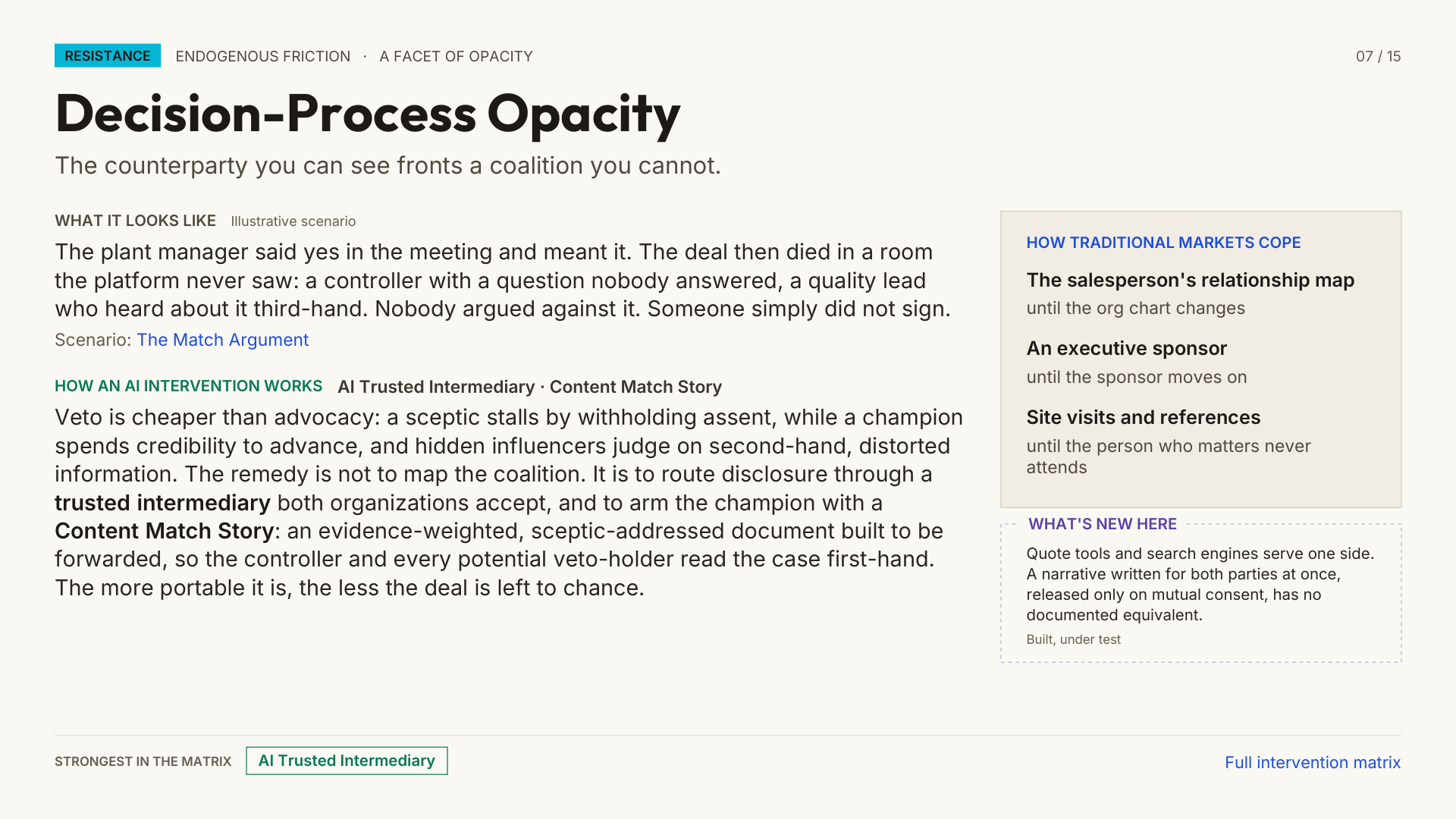
07Decision-Process Opacity Open cardPNG
Resistance Endogenous frictionA facet of Opacity 07 / 15

Decision-Process Opacity

The counterparty you can see fronts a coalition you cannot.

What it looks like Illustrative scenario

The plant manager said yes in the meeting and meant it. The deal then died in a room the platform never saw: a controller with a question nobody answered, a quality lead who heard about it third-hand. Nobody argued against it. Someone simply did not sign.

How an AI intervention works AI Trusted Intermediary · Content Match Story

Veto is cheaper than advocacy: a sceptic stalls by withholding assent, while a champion spends credibility to advance, and hidden influencers judge on second-hand, distorted information. The remedy is not to map the coalition. It is to route disclosure through a trusted intermediary both organizations accept, and to arm the champion with a Content Match Story: an evidence-weighted, sceptic-addressed document built to be forwarded, so the controller and every potential veto-holder read the case first-hand. The more portable it is, the less the deal is left to chance.

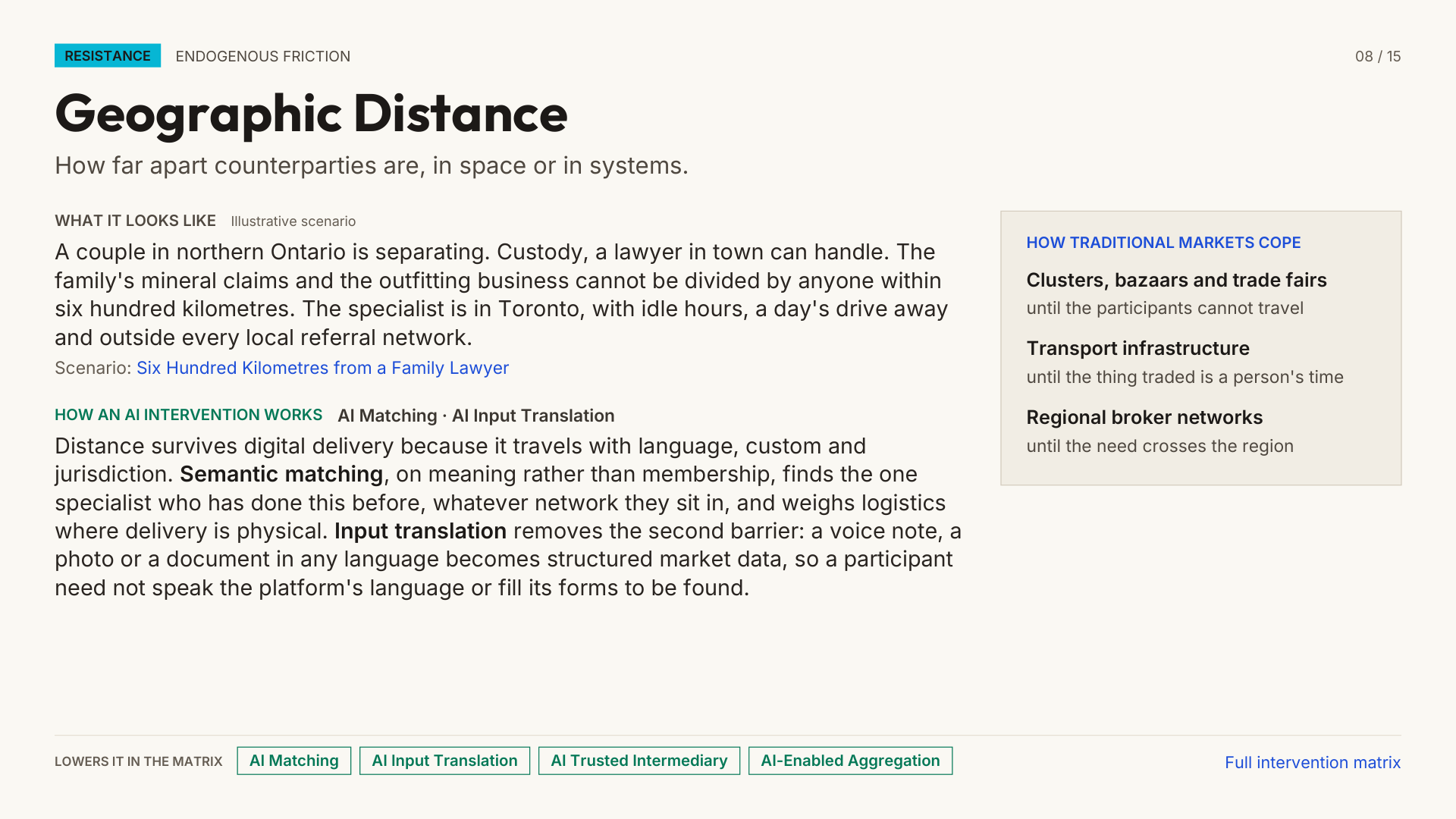
08Geographic Distance Open cardPNG
Resistance Endogenous friction 08 / 15

Geographic Distance

How far apart counterparties are, in space or in systems.

What it looks like Illustrative scenario

A couple in northern Ontario is separating. Custody, a lawyer in town can handle. The family's mineral claims and the outfitting business cannot be divided by anyone within six hundred kilometres. The specialist is in Toronto, with idle hours, a day's drive away and outside every local referral network.

How an AI intervention works AI Matching · AI Input Translation

Distance survives digital delivery because it travels with language, custom and jurisdiction. Semantic matching, on meaning rather than membership, finds the one specialist who has done this before, whatever network they sit in, and weighs logistics where delivery is physical. Input translation removes the second barrier: a voice note, a photo or a document in any language becomes structured market data, so a participant need not speak the platform's language or fill its forms to be found.

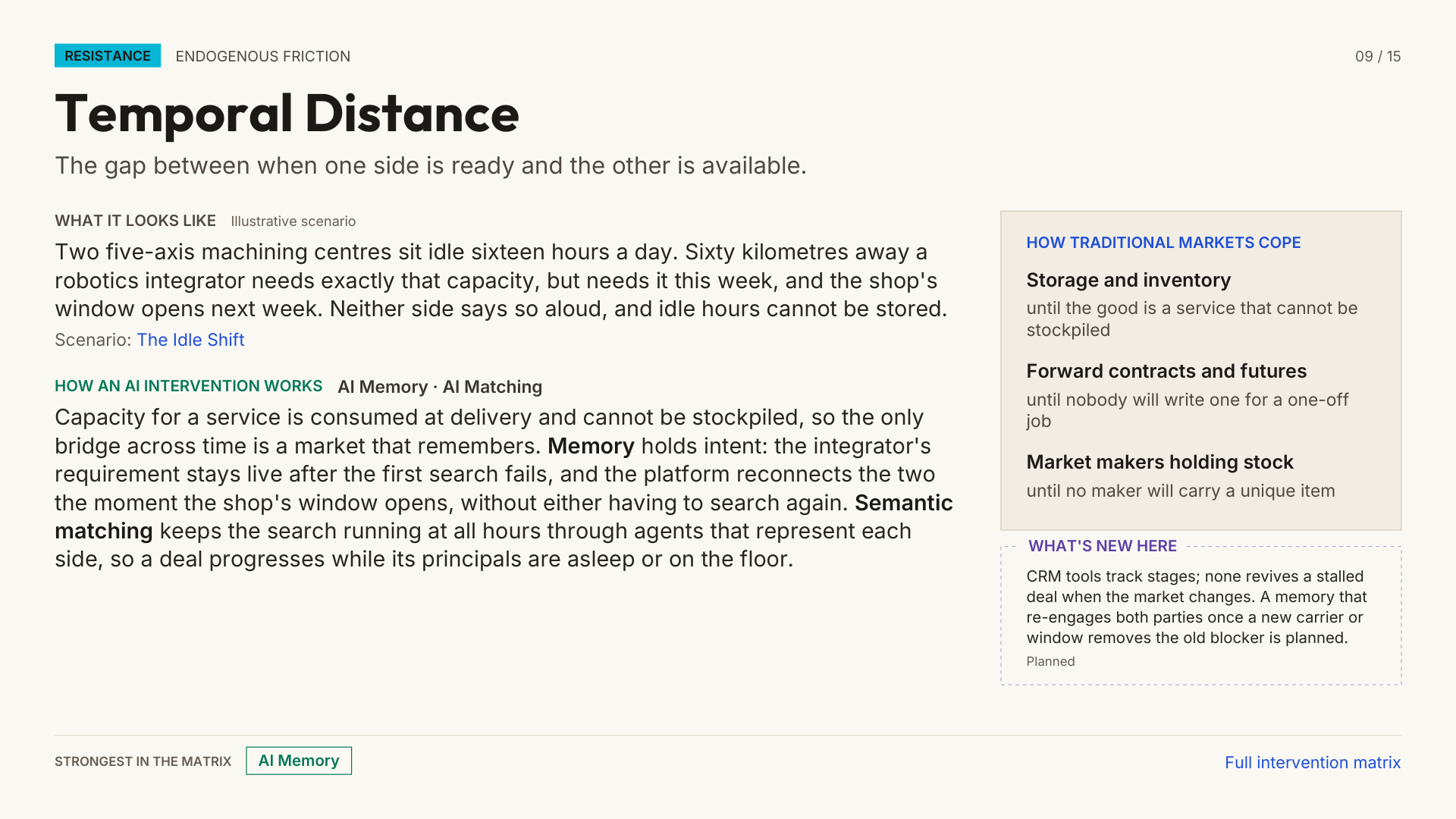
09Temporal Distance Open cardPNG
Resistance Endogenous friction 09 / 15

Temporal Distance

The gap between when one side is ready and the other is available.

What it looks like Illustrative scenario

Two five-axis machining centres sit idle sixteen hours a day. Sixty kilometres away a robotics integrator needs exactly that capacity, but needs it this week, and the shop's window opens next week. Neither side says so aloud, and idle hours cannot be stored.

How an AI intervention works AI Memory · AI Matching

Capacity for a service is consumed at delivery and cannot be stockpiled, so the only bridge across time is a market that remembers. Memory holds intent: the integrator's requirement stays live after the first search fails, and the platform reconnects the two the moment the shop's window opens, without either having to search again. Semantic matching keeps the search running at all hours through agents that represent each side, so a deal progresses while its principals are asleep or on the floor.

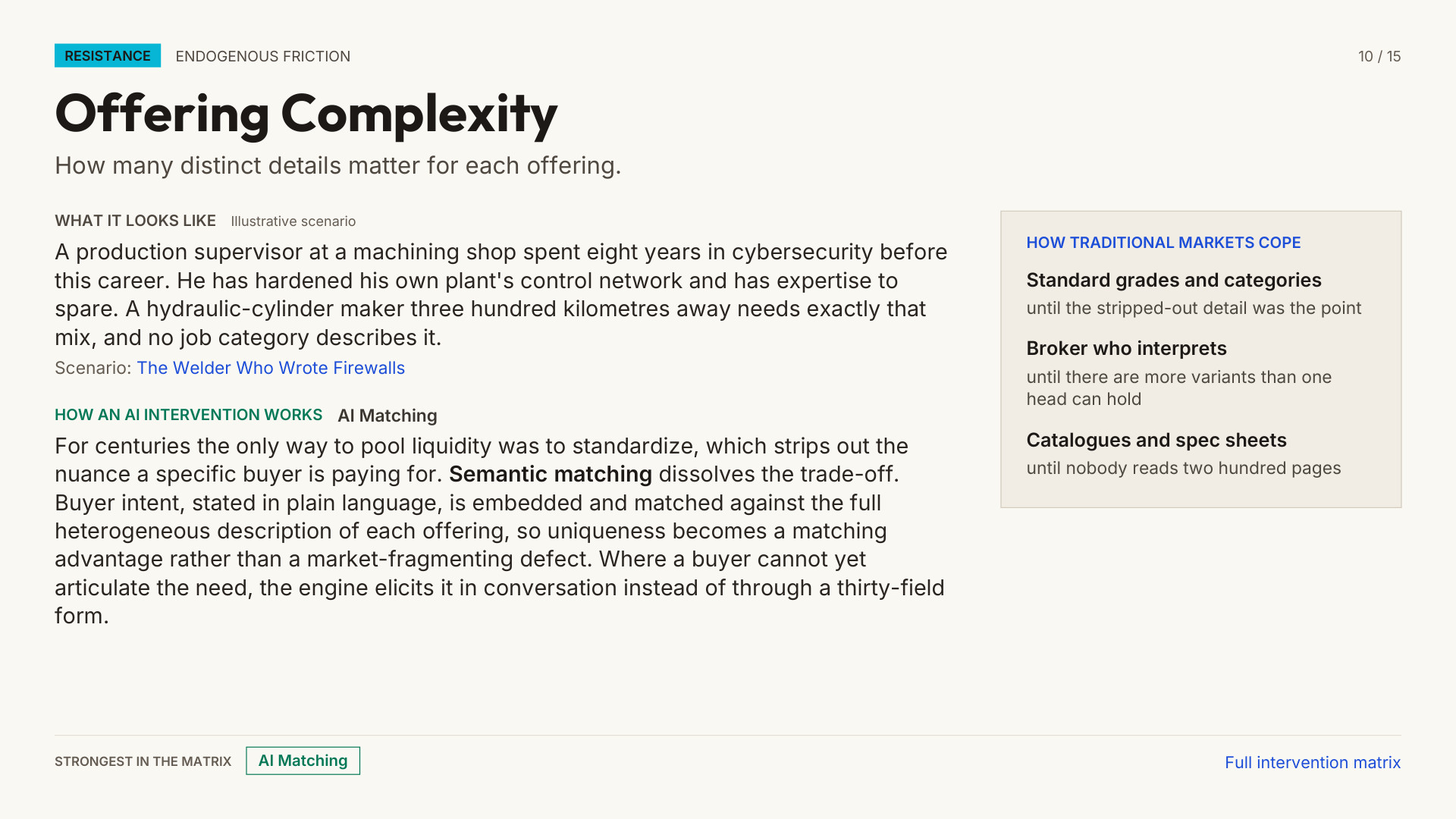
10Offering Complexity Open cardPNG
Resistance Endogenous friction 10 / 15

Offering Complexity

How many distinct details matter for each offering.

What it looks like Illustrative scenario

A production supervisor at a machining shop spent eight years in cybersecurity before this career. He has hardened his own plant's control network and has expertise to spare. A hydraulic-cylinder maker three hundred kilometres away needs exactly that mix, and no job category describes it.

How an AI intervention works AI Matching

For centuries the only way to pool liquidity was to standardize, which strips out the nuance a specific buyer is paying for. Semantic matching dissolves the trade-off. Buyer intent, stated in plain language, is embedded and matched against the full heterogeneous description of each offering, so uniqueness becomes a matching advantage rather than a market-fragmenting defect. Where a buyer cannot yet articulate the need, the engine elicits it in conversation instead of through a thirty-field form.

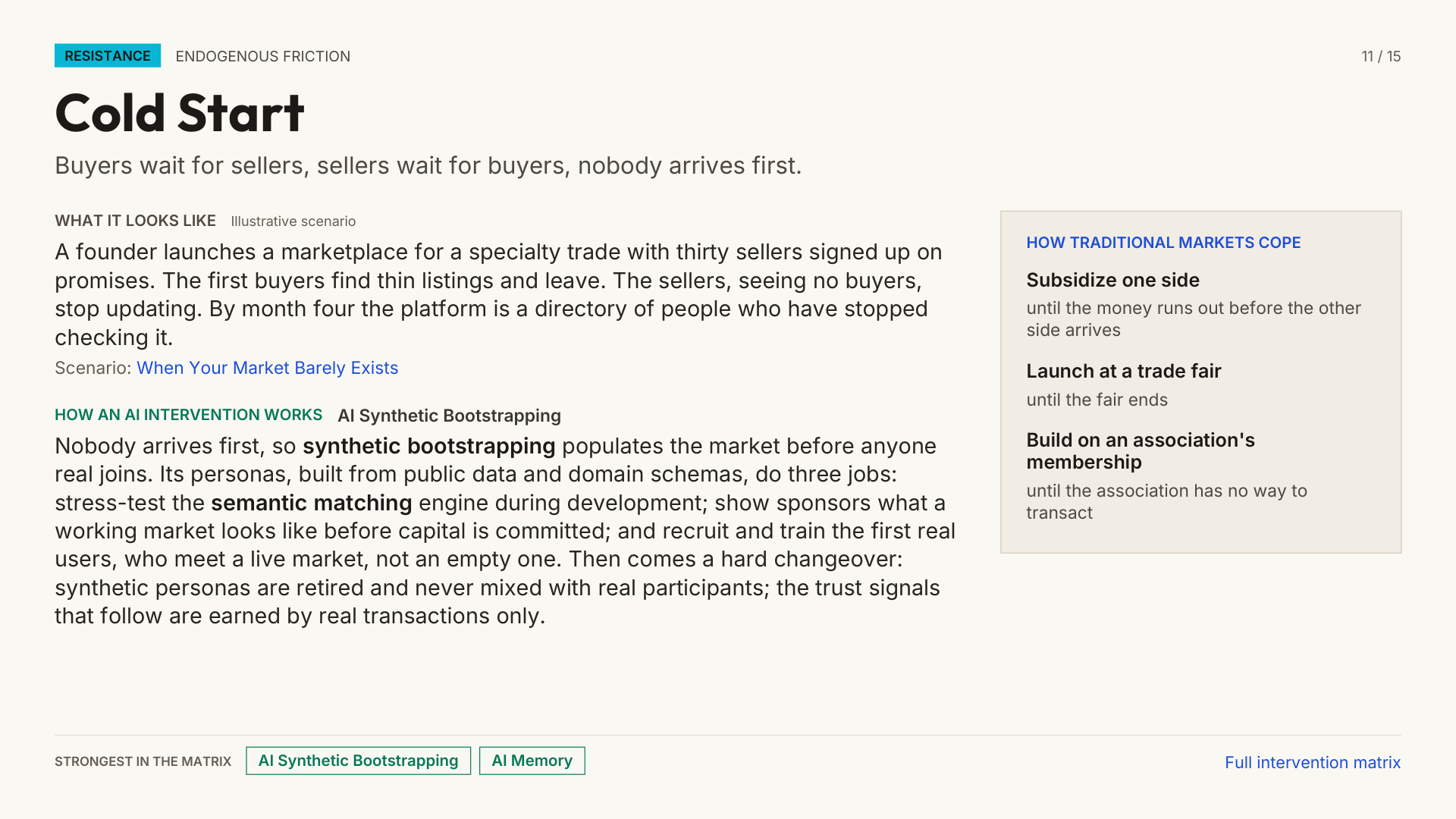
11Cold Start Open cardPNG
Resistance Endogenous friction 11 / 15

Cold Start

Buyers wait for sellers, sellers wait for buyers, nobody arrives first.

What it looks like Illustrative scenario

A founder launches a marketplace for a specialty trade with thirty sellers signed up on promises. The first buyers find thin listings and leave. The sellers, seeing no buyers, stop updating. By month four the platform is a directory of people who have stopped checking it.

How an AI intervention works AI Synthetic Bootstrapping

Nobody arrives first, so synthetic bootstrapping populates the market before anyone real joins. Its personas, built from public data and domain schemas, do three jobs: stress-test the semantic matching engine during development; show sponsors what a working market looks like before capital is committed; and recruit and train the first real users, who meet a live market, not an empty one. Then comes a hard changeover: synthetic personas are retired and never mixed with real participants; the trust signals that follow are earned by real transactions only.

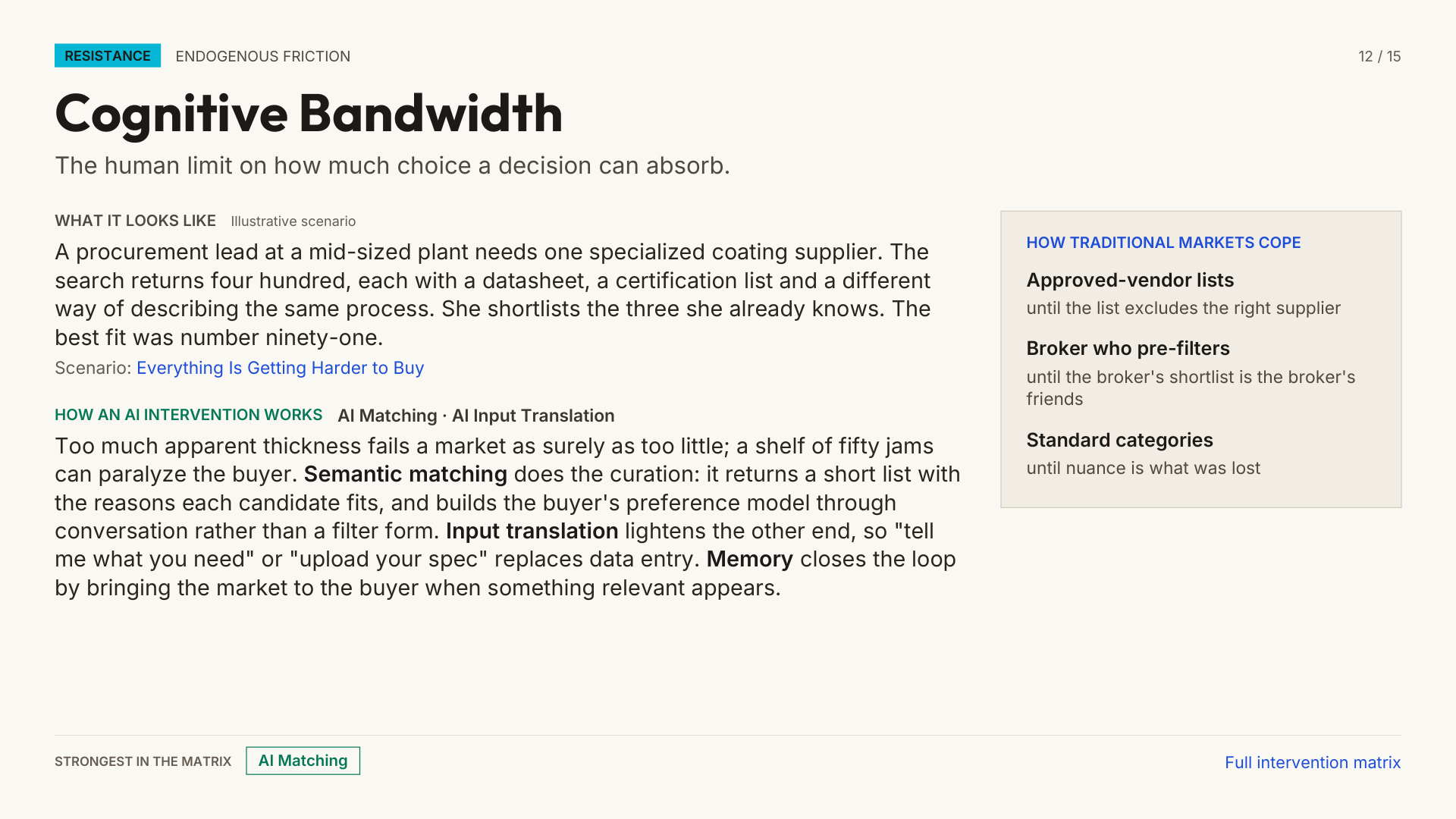
12Cognitive Bandwidth Open cardPNG
Resistance Endogenous friction 12 / 15

Cognitive Bandwidth

The human limit on how much choice a decision can absorb.

What it looks like Illustrative scenario

A procurement lead at a mid-sized plant needs one specialized coating supplier. The search returns four hundred, each with a datasheet, a certification list and a different way of describing the same process. She shortlists the three she already knows. The best fit was number ninety-one.

How an AI intervention works AI Matching · AI Input Translation

Too much apparent thickness fails a market as surely as too little; a shelf of fifty jams can paralyze the buyer. Semantic matching does the curation: it returns a short list with the reasons each candidate fits, and builds the buyer's preference model through conversation rather than a filter form. Input translation lightens the other end, so "tell me what you need" or "upload your spec" replaces data entry. Memory closes the loop by bringing the market to the buyer when something relevant appears.

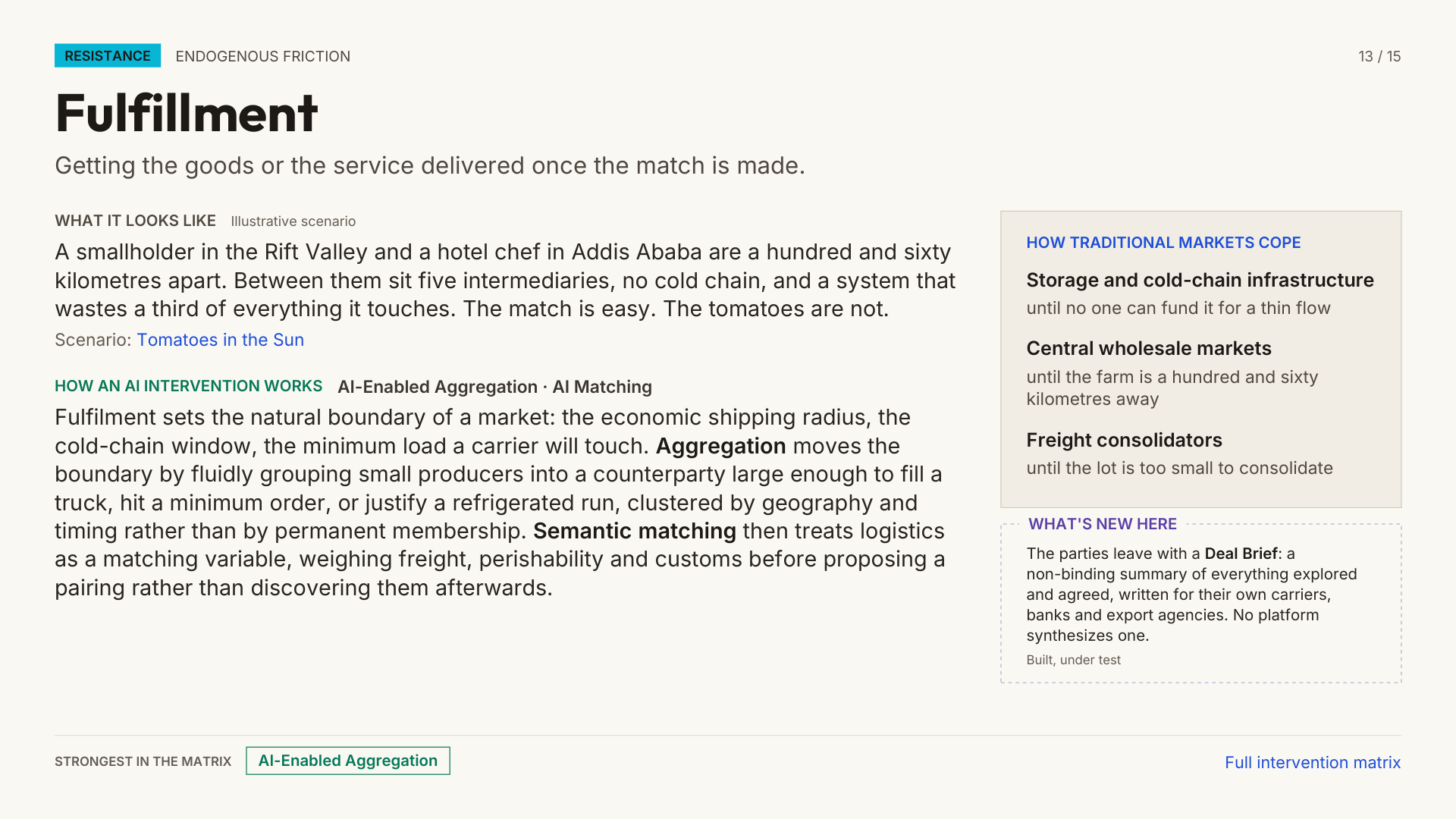
13Fulfillment Open cardPNG
Resistance Endogenous friction 13 / 15

Fulfillment

Getting the goods or the service delivered once the match is made.

What it looks like Illustrative scenario

A smallholder in the Rift Valley and a hotel chef in Addis Ababa are a hundred and sixty kilometres apart. Between them sit five intermediaries, no cold chain, and a system that wastes a third of everything it touches. The match is easy. The tomatoes are not.

How an AI intervention works AI-Enabled Aggregation · AI Matching

Fulfilment sets the natural boundary of a market: the economic shipping radius, the cold-chain window, the minimum load a carrier will touch. Aggregation moves the boundary by fluidly grouping small producers into a counterparty large enough to fill a truck, hit a minimum order, or justify a refrigerated run, clustered by geography and timing rather than by permanent membership. Semantic matching then treats logistics as a matching variable, weighing freight, perishability and customs before proposing a pairing rather than discovering them afterwards.

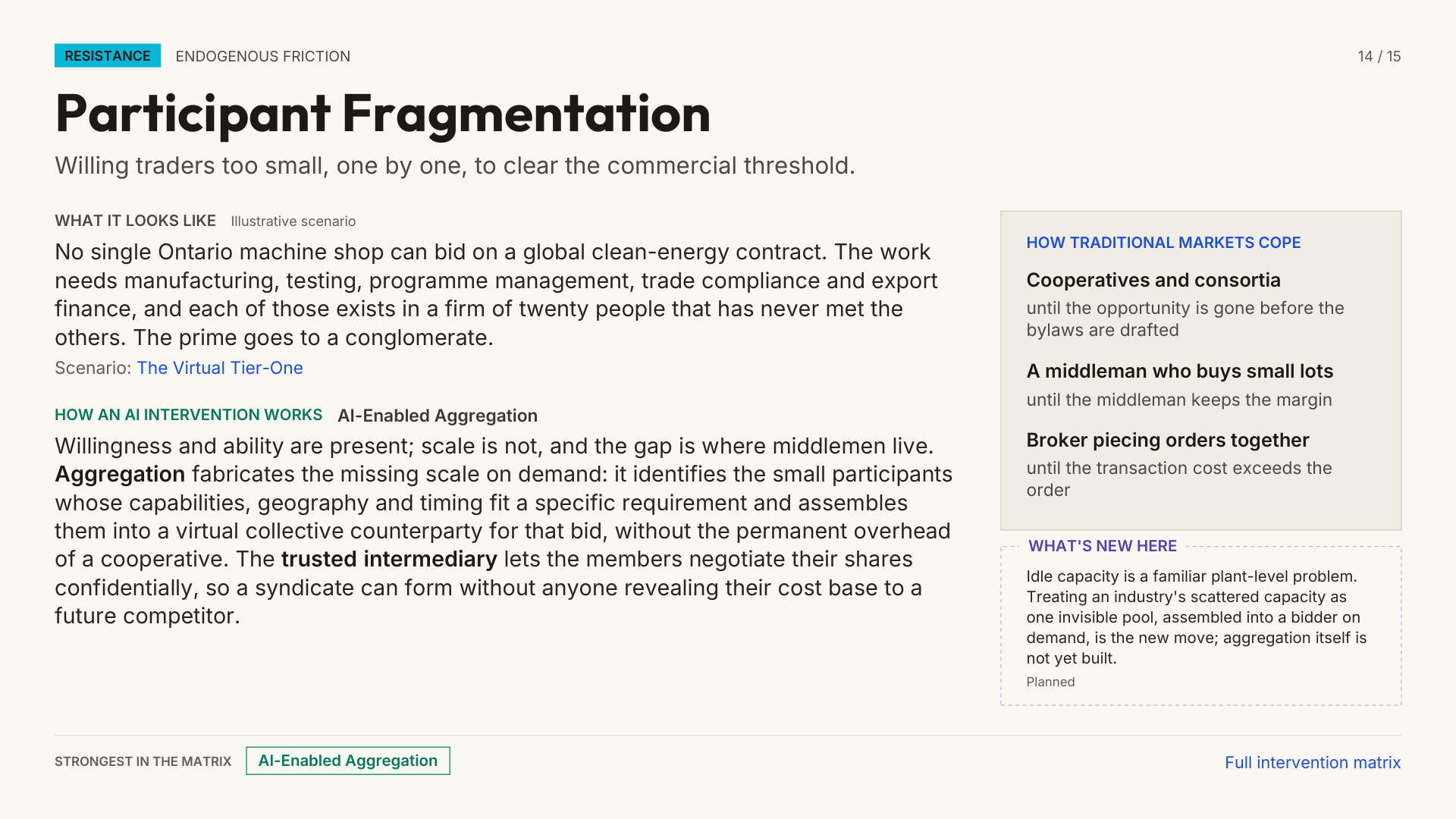
14Participant Fragmentation Open cardPNG
Resistance Endogenous friction 14 / 15

Participant Fragmentation

Willing traders too small, one by one, to clear the commercial threshold.

What it looks like Illustrative scenario

No single Ontario machine shop can bid on a global clean-energy contract. The work needs manufacturing, testing, programme management, trade compliance and export finance, and each of those exists in a firm of twenty people that has never met the others. The prime goes to a conglomerate.

How an AI intervention works AI-Enabled Aggregation

Willingness and ability are present; scale is not, and the gap is where middlemen live. Aggregation fabricates the missing scale on demand: it identifies the small participants whose capabilities, geography and timing fit a specific requirement and assembles them into a virtual collective counterparty for that bid, without the permanent overhead of a cooperative. The trusted intermediary lets the members negotiate their shares confidentially, so a syndicate can form without anyone revealing their cost base to a future competitor.

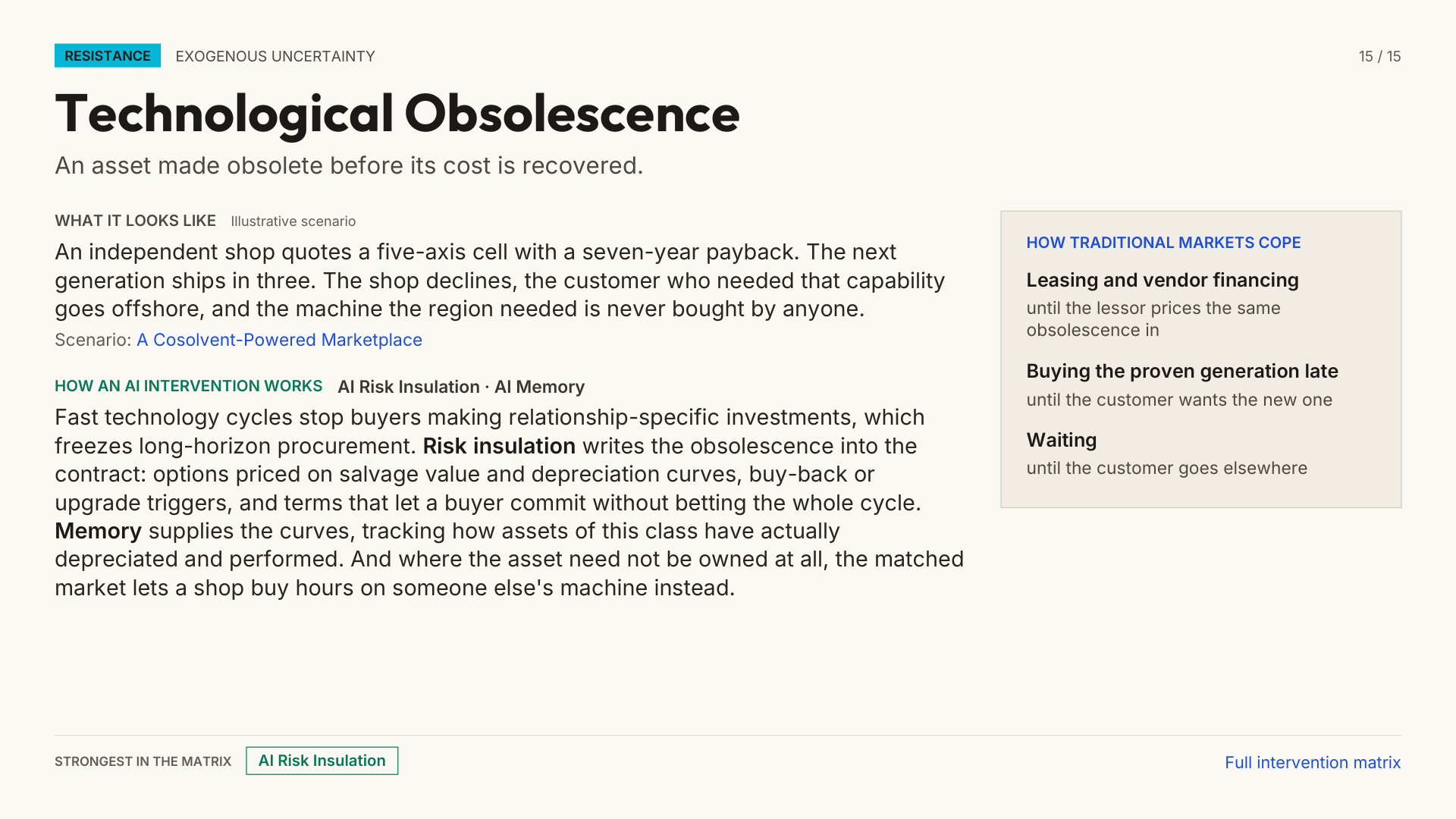
15Technological Obsolescence Open cardPNG
Resistance Exogenous uncertainty 15 / 15

Technological Obsolescence

An asset made obsolete before its cost is recovered.

What it looks like Illustrative scenario

An independent shop quotes a five-axis cell with a seven-year payback. The next generation ships in three. The shop declines, the customer who needed that capability goes offshore, and the machine the region needed is never bought by anyone.

How an AI intervention works AI Risk Insulation · AI Memory

Fast technology cycles stop buyers making relationship-specific investments, which freezes long-horizon procurement. Risk insulation writes the obsolescence into the contract: options priced on salvage value and depreciation curves, buy-back or upgrade triggers, and terms that let a buyer commit without betting the whole cycle. Memory supplies the curves, tracking how assets of this class have actually depreciated and performed. And where the asset need not be owned at all, the matched market lets a shop buy hours on someone else's machine instead.

Scenarios are illustrative. Challenge definitions and matrix effects follow the DeeperPoint Intervention Matrix (canonical reference v4.0); the traditional tools follow Part IV of the whitepaper. Where a card carries an originality note, it follows DeeperPoint's originality review of 2026-11-05 and says whether the capability is built or planned. Built 2026-11-05.