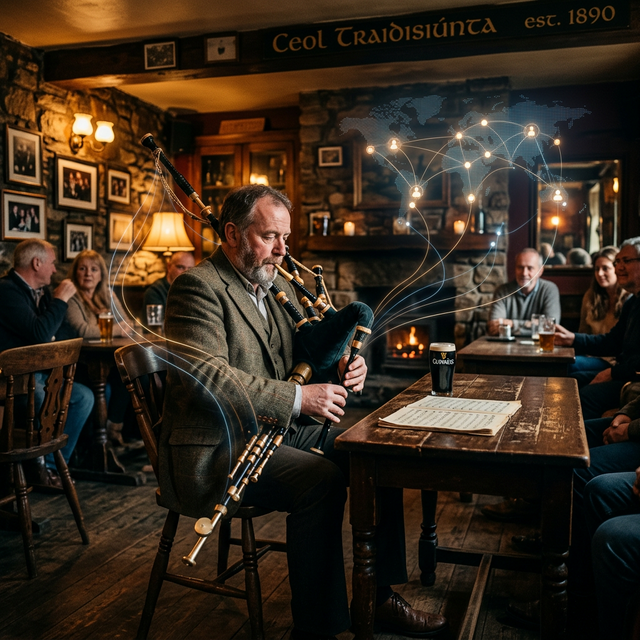
The Global Thin Market Nobody Built
Irish traditional music — one of the world’s most vital living folk traditions — has built a genuinely global community of practitioners, teachers, makers, and cultural organizations that generates substantial, highly fragmented demand for cultural services and craft products.
Yet, this community currently operates almost entirely on word of mouth, private social media groups, festival networking, and a handful of session-finder websites that serve only the already-connected fraction of a global market.
The problem isn’t talent. The problem isn’t interest. The problem is that nobody has built the plumbing.
What if a platform could match the specific artistic profile and availability of an Irish traditional musician in Clare with the specific engagement needs of a cultural festival director in Buenos Aires — not by keyword search, but by understanding the actual qualities of the music, the teaching, and the cultural context?
That’s the thin market engineering problem. And to show what a platform like MarketForge could make possible, let me tell you a story. The characters you’re about to meet are fictional — but the traditions, the market forces, and the platform architecture are real. This is a scenario, not a case study: a detailed illustration of what thin market automation could look like if the infrastructure existed.
1. Caitlín’s Profile
Caitlín Ní Dhonnabháin is a concertina player and sean-nós singer from Miltown Malbay, County Clare. She won the All-Ireland senior concertina title twice, she learned the West Clare concertina style directly from an elderly master, and she holds a Higher Diploma in Arts Education with a specialisation in traditional music pedagogy.
Caitlín teaches part-time and plays sessions. She supplements her income with workshops at festivals during the summer, mostly within Ireland. She has never performed or taught outside Europe.
She is a high-value supply-side participant who is invisible to the vast majority of the demand side. A cultural center in Melbourne looking for precisely her combination — a master-class-level concertina player with specific West Clare stylistic lineage and formal teaching credentials — would have almost no way to find her. They might post on forums or ask around at sessions, but these mechanisms depend on pre-existing social connections and favour musicians who already have international profiles.
Caitlín does not have an international profile. She has deep skill, regional stylistic specificity, and formal pedagogical training — exactly the combination that cultural organizations worldwide are looking for. She just has no way to signal it beyond West Clare.
She opens an app piloted by a partnership between the Irish Traditional Music Archive (ITMA) and Ealaín na Gaeltachta (the arts body serving Ireland’s Irish-speaking regions). The platform is called Ceol Ceangal — “Music Connection”.
The app asks her to describe herself. She talks for a few minutes about what she plays, her regional style, her teaching approach, and the kinds of engagements she’s open to. She uploads three short audio recordings and a CV.
The platform’s multimodal pipeline transcribes her audio descriptions, extracts structured data — concertina, West Clare style, sean-nós vocals, pedagogical certification, workshop delivery — and builds a layered profile. The gallery profile shows her public information and a narrative bio. The matching profile includes richer signals visible only to the matching engine: her availability, travel willingness, fee expectations, and comfort level with different audience types.
2. Martín’s Search
Nine thousand kilometers to the southwest, in Buenos Aires, Martín Echeverría is the programme director of the Centro Cultural Irlandés, an established Irish cultural center running a traditional music residency programme.
The programme is successful, but sourcing artists is a persistent problem. Martín needs a specific kind of musician: a tradition-bearer who carries a specific regional style, can teach that style to intermediate players, and is comfortable working with a Spanish-speaking audience. He needs someone who can explain not just what to play but why this tune sits in this tradition.
His current sourcing method relies on emailing friends and attending festivals in Ireland to make connections in person. He finds one musician per year, but he has no way to systematically compare candidates or discover musicians outside his existing network.
Martín registers the Centro as a demand-side participant on Ceol Ceangal.
The platform asks him to describe an ideal residency. Martín outlines a two-week engagement with workshop sessions, a public concert, and an artist talk. He wants someone with strong concertina or fiddle skills in a recognisable regional tradition. Formal teaching experience and a willingness to work with a Spanish-language interpreter are essential. He inputs the Centro’s budget for the residency.
3. The Match
The semantic matching engine — Cosolvent’s Module 1 — compares Martín’s engagement profile against the embedding vectors generated from supply-side participants. Caitlín is a high-confidence match across multiple dimensions: regional style specificity (West Clare concertina — a tradition the Buenos Aires session community has been specifically requesting), formal pedagogical training, and workshop delivery experience. Her matching profile indicates willingness to travel internationally and comfort with structuring material for non-native cultural contexts.
The match rationale, shown to Martín in Spanish, says:
“Martín, hemos encontrado una concertinista en el condado de Clare, Irlanda, cuyo estilo regional — la tradición del oeste de Clare — coincide con lo que su comunidad ha solicitado. Tiene formación pedagógica formal en música tradicional y experiencia en la entrega de talleres a niveles intermedios y avanzados. Su perfil indica disposición para viajes internacionales y experiencia trabajando con públicos que no son hablantes nativos de inglés. ¿Desea ver su perfil de galería?”
Caitlín receives a parallel notification:
“Caitlín, we’ve found a cultural centre in Buenos Aires, Argentina, that is looking for a concertina player in a specific regional tradition for a two-week teaching residency. Your West Clare style and your pedagogical credentials are a strong match for what they need. The centre has a 25-year history of hosting Irish musicians and a musically serious community of traditional players. Would you like to see their profile?”
This is not keyword search. The platform did not search for “concertina player available for travel.” It identified, through the semantic structure of Caitlín’s artistic profile — her stylistic lineage, her pedagogical approach, her repertoire characteristics, her transmission heritage — that she is the kind of tradition-bearer Martín has been unsuccessfully searching his personal network for.
Both say yes.
4. The CommonContext in Action
Before Caitlín responds to the Centro’s enquiry, she has questions. She has never been to South America. She doesn’t speak Spanish. She doesn’t know what an Irish traditional music workshop looks like in Buenos Aires — what level the players are, what tunes they know, what regional styles they’ve been exposed to.
She asks the platform’s chatbot: “What is the Irish traditional music scene in Buenos Aires like? What level should I expect the workshop participants to be?”
The platform routes her query to the CommonContext — the sponsor-curated reference library populated by the ITMA partnership. But the sponsor hadn’t anticipated this specific question. The CommonContext has extensive curated guidance on teaching in translation and Argentine visa requirements, but no specific profile of the Buenos Aires session community.
Ten years ago, a platform would have returned “No results found.” But MarketForge handles knowledge gaps differently.
First, the AI falls back to a broad external search, synthesizing public information into a provisional answer clearly flagged as unverified:
“External Synthesis (Unverified): Public sources indicate the Centro Cultural Irlandés has hosted Irish musicians since 1999 and maintains an active session community. However, specific participant proficiency levels and regional style preferences are not documented in our verified library.”
Simultaneously, the platform fires a “Curatorial Pull Signal” to the sponsor administrator dashboard at ITMA: Knowledge Gap Detected: High-value supplier querying demand-side community proficiency for Buenos Aires engagement.
This is demand-driven curation. Instead of asking sponsors to exhaustively document the entire global ecosystem upfront — a massive barrier to adoption — the platform uses active market queries to identify exactly what knowledge has commercial value.
An administrator at ITMA sees the pull signal. Recognizing a high-potential match is stalled on a knowledge gap, they reach out to their contacts at the Argentine Federación. Within a few hours, they draft a concise, authoritative profile of the Buenos Aires community and commit it to the CommonContext.
Caitlín receives a notification that her query has a verified update:
“Sponsor Update (ITMA): The Centro’s session community includes approximately 40 regular players, mostly at intermediate level. The community’s repertoire is weighted toward East Galway material. They are highly committed but have had little exposure to West Clare concertina ornamentation. Providing structured breakdown of rolls and cuts will be highly valued.”
Caitlín could not have found this specific, contextual insight through a web search. It comes from the on-demand curation of the sponsor, unblocking the transaction and permanently enriching the CommonContext for all future platform users.
5. The Conversation
Caitlín and Martín are now in a match-scoped communication channel. The platform provides AI-assisted translation — Martín writes in Spanish, Caitlín reads in English, and vice versa.
The exchange is practical. Martín shares a video from last year’s residency. Caitlín watches it and notes their strong rhythmic sense, suggesting they focus on specific ornamentation. They co-design the residency programme: workshop sessions on West Clare concertina style, ornamentation, sean-nós singing, and an artist talk.
6. The Deal
When both parties confirm the engagement, the platform moves into deal structuring. The residency requires specific facilitation:
- Travel logistics: The CommonContext provides visa requirements, and a travel coordinator from the platform’s facilitator pool is engaged.
- Technical requirements: Caitlín needs an unamplified venue with good natural reverb. The CommonContext suggests suitable venues in Buenos Aires based on previous residencies.
- Payment: The platform structures the payment in tranches through the Centro’s existing grant mechanism, providing the necessary documentation trail.
The deal structure — principal participants, facilitators, role assignments, timeline, and fee structure — is assembled in a Deal Brief that both parties review and confirm.
8. What Makes This a Thin Market Story
Step back from the narrative and look at the structural forces that prevented these connections before:
Discovery — Caitlín in Clare and Martín in Buenos Aires are 9,000 kilometers apart, in different languages, in different institutional networks. Martín’s existing sourcing method — emailing friends, posting in Facebook groups, attending the Fleadh — could never have surfaced a musician whose primary credential is stylistic lineage from a deceased master concertina player in West Clare. The platform’s semantic matching, operating on embeddings derived from audio recordings, teaching descriptions, and stylistic metadata, makes this discovery possible.
Opacity — Supply capacity (e.g., a workshop slot opening unexpectedly) remains invisible to global demand without persistent matching infrastructure.
Knowledge asymmetry and demand-driven curation — Caitlín had never taught outside Europe. She didn’t know what to expect from a Buenos Aires audience, how to structure material for interpretation into Spanish, or what regional styles the community had and hadn’t been exposed to. The CommonContext doesn’t just act as a static library — it uses “curatorial pull signals” to tell the sponsor exactly what knowledge is missing to close a deal. By allowing user queries to drive curation, the platform systematically closes knowledge gaps without requiring sponsors to document the entire world upfront. Without that verified institutional knowledge, Caitlín might have declined the engagement out of uncertainty.
Geographic and temporal distance — The Irish traditional music market is one of the most geographically dispersed cultural markets in the world. Session communities exist in Buenos Aires, Tokyo, Cape Town, Sydney, Vancouver, Berlin, and dozens of other cities — all generating demand for authentic Irish practitioners who are concentrated in a small island on the western edge of Europe. The temporal mismatch is equally severe: a festival director books artists nine to twelve months in advance, but a musician’s availability changes week to week. Without persistent, asynchronous matching — where the platform holds both supply-side profiles and demand-side requirements and matches them continuously — these temporally separated participants never connect.
The sponsor’s role — What the platform doesn’t do alone. The ITMA partnership carries the cultural authority that makes the platform trustworthy to musicians — traditional musicians are deeply wary of platforms that might commodify or misrepresent their art. Ealaín na Gaeltachta provides the Irish-language and Gaeltacht cultural context. The Federación in Argentina provides the diaspora institutional connection. These sponsors populate the CommonContext, verify musician credentials, and provide the cultural legitimacy that no software platform can generate on its own.
9. Scaling the Model: Instruments, Costumes, Arrangements, and More
Caitlín’s residency illustrates one thread in a broader ecosystem. The platform’s matching, curation, and deal-structuring logic scales seamlessly to other cultural services and artifacts:
- Instruments: Connect makers with sudden capacity (cancellations, overproduction) to buyers specifying tonal profiles, materials, or regional preferences via audio analysis.
- Costumes and attire: Match specialist seamstresses crafting set-dancing dresses or step-dance shoes with festival organizers needing authentic, custom pieces.
- Arrangements and notation: Pair composers creating regional medleys or session sets with leaders seeking fresh material for diaspora groups.
- Teaching materials: Curate and match digital resources—tunebooks, video ornamentation breakdowns, style guides—to learners at specific proficiency levels.
Ireland’s music industry generates €1 billion annually, employing 13,400 people, with live music contributing €786 million [1][3][4]. Traditional music, enjoyed by ~30% of adults [6], represents untapped potential in this fragmented global market.
10. After the First Residency
Caitlín’s two weeks in Buenos Aires are, by the Centro’s reckoning, the most successful residency they’ve run in five years. The platform remembers. It remembers that Caitlín’s combination — concertina, West Clare lineage, sean-nós capability, pedagogical training — generated exceptionally positive engagement from an intermediate-level diaspora community. It remembers the specific workshop formats that worked and the ones that didn’t. It stores this outcome data — anonymised, aggregated — and uses it to refine future matches.
When a cultural centre in Melbourne registers on the platform six months later, looking for a concertina workshop leader, the matching engine doesn’t start from zero. It draws on the Buenos Aires outcome data — together with Caitlín’s updated profile and availability — and proposes her with higher confidence.
And Caitlín is no longer invisible. Her profile now includes a verified residency history, participant feedback, and outcome data. The next cultural organisation that browses the platform sees not just her credentials but her track record — the kind of evidence-based trust that takes years to build through personal networking, compressed into a single engagement cycle.
The thin market begins to thicken. Not because there are suddenly more concertina players or more cultural festivals — but because the matching infrastructure makes the existing supply and existing demand visible to each other for the first time.
The stories of Caitlín and Martín are fictional — imagined scenarios, not descriptions of an existing platform or real participants. But the traditions described are real, the market forces are documented, and the engine architecture (Cosolvent, CommonContext) is under active development. This post illustrates the kind of application a sponsor coalition like ITMA and Ealaín na Gaeltachta could build using those tools. The operational details — which musicians to include, how to verify stylistic credentials, how to navigate the cultural sensitivities of tradition-bearing communities, how to structure residency agreements across jurisdictions — are rightly the work of sponsors embedded in the specific context. The platform provides the matching infrastructure and the domain knowledge layer; the context is always local.
A note on timing: Irish traditional music is a niche cultural market — beautiful, global, and genuinely thin, but unlikely to be the first thin market that a platform like MarketForge would serve. The more probable path is that larger, more commercially urgent thin markets — agricultural commodities, cross-border professional services, industrial procurement — prove the infrastructure first. Once the open-source tools are mature and the development path is well-trodden, that is when a market this specialised becomes practical. The plumbing has to exist before you can run water through it.
What makes a thin market tick? → · The MarketForge platform → · Who should build this? →