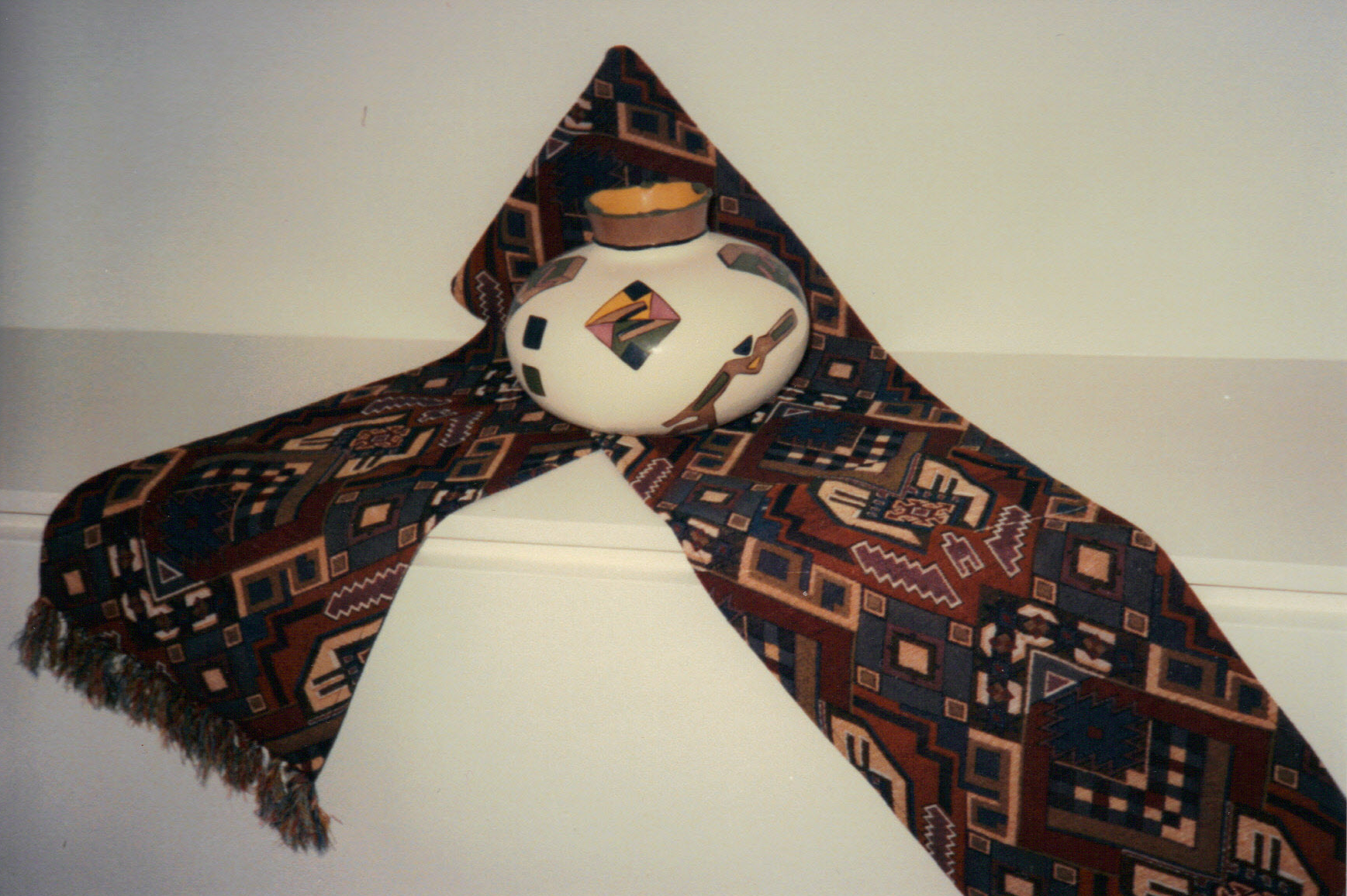
The Set That Started It
About fifteen years ago, my wife came home from a trip to Turkey with a collection of fabrics — richly patterned textiles with the kind of floral density and earthy color palette that Anatolian weavers have been perfecting for centuries. She brought them back to Alabama with no specific plan, just the conviction that they were too beautiful to leave in a shop.
Her friend, a ceramic artist, looked at one of them and started thinking. She took a piece of unfired greenware pottery and began working — adjusting the clay itself, then developing and hand-painting a design that was intended not to copy the fabric but to respond to it. The same botanical vocabulary, interpreted in a different medium, at a different scale, in a different material weight and texture.
The result was a vase that belonged with that table runner. Together they were something more than two crafted objects. They were a set — a composed aesthetic statement that neither piece could make alone.
They made about ten sets. Every one was wonderful. And then life intervened, and they never followed through to market the work.
I’ve been thinking about that story ever since I started working on thin market theory. Because what happened in that Alabama living room was also the sketch of a market that doesn’t currently exist — and probably should.
The collaboration worked because of proximity and friendship. Two people in the same town, who knew each other, who could hold the fabric next to the clay and adjust in real time. It was intimate, intuitive, and entirely unrepeatable at any distance.
But what if it didn’t have to be?
What if the aesthetic compatibility that my wife’s friend recognized — the shared botanical vocabulary between an Anatolian textile and an American ceramic surface — could be detected computationally, across hundreds of kilometers, between artisans who have never met? What if a platform could find those aesthetic correspondences, support the creative conversation, structure the deal, and connect the resulting set with the buyers who would recognize its value?
That’s the thin market engineering problem. And to show what a platform like MarketForge could make possible, let me tell you a story. The two artisans you’re about to meet are fictional — but the craft traditions, the market forces, and the platform architecture are real. This is a scenario, not a case study: a detailed illustration of what thin market automation could look like if the infrastructure existed.
1. Luisa’s Morning
Luisa Reyes has been making pottery in Dolores Hidalgo, Guanajuato, since she was fourteen. Her grandmother taught her the majólica technique — the tin-glazed earthenware that traveled from Spain to Mexico in the sixteenth century and took local root. Luisa’s specialty is botanical glazework: dense, layered floral motifs painted freehand in a palette of cobalt, ochre, and oxide green. She fires in the same wood-burning kiln her family has used for three generations.
She sells at the weekend market in town and, occasionally, to a buyer from Mexico City who visits twice a year and pays decently but always wants smaller pieces — mugs, tiles, ornamental plates. The large-format work Luisa loves — oversized vases, statement bowls, sculptural forms — sits in her workshop. Beautiful, unsold, and increasingly difficult to justify making.
Luisa has a smartphone, intermittent Wi-Fi, and fluent Spanish. She does not have an international distribution network, a portfolio website, or any way to reach the kind of buyer who would understand that her large-format glazework is not a souvenir. It is a serious artistic statement rooted in four centuries of ceramic tradition.
This morning, she opens an app she was introduced to by a representative from FONART — the Mexican government’s national fund for artisan development. The app is the front end of a thin market platform her regional artisan cooperative has joined. She doesn’t know what “Cosolvent” is, doesn’t need to. She knows the platform as Enlace Artesanal — the name the FONART sponsor chose when they configured the deployment.
The app wants to know more about her work. It asks her in Spanish — conversational, not bureaucratic — to describe what she makes, what materials she uses, what traditions she draws from, and what kind of projects she dreams about but has never been able to pursue.
She talks into her phone for four minutes. The platform’s multimodal input pipeline transcribes her voice, extracts structured data — ceramic, majólica, botanical motifs, cobalt palette, large-format, Dolores Hidalgo, Guanajuato — and builds a profile that lives in two layers: a gallery profile visible to anyone browsing, and a matching profile that includes richer signals — her pricing flexibility, her production capacity, her willingness to collaborate, the aesthetic vocabularies she responds to — visible only to the AI matching engine, never displayed to other users.
She also uploads photos. Six images of her best large-format pieces, shot on her phone against the adobe wall of her workshop. The platform’s vision model extracts color palette data, motif density, surface texture characteristics, and compositional structure — information that will be used for aesthetic matching but never shown as raw data.
Luisa puts her phone down and goes back to work.
2. Rodrigo’s Afternoon
Eight hundred kilometers to the south, in Teotitlán del Valle, Oaxaca, Rodrigo Méndez is unwinding a finished textile from his loom. Teotitlán is one of the most celebrated weaving villages in Mexico — the Zapotec tradition here predates the Spanish conquest. Rodrigo’s family has been weaving for at least five generations. He works with hand-spun wool dyed with natural pigments: cochineal for reds, indigo for blues, pomegranate rind for yellows, huizache bark for browns.
Rodrigo’s pieces are large-format too — wall hangings, table runners, floor textiles — and his patterns are geometric-botanical hybrids: angular Zapotec diamond motifs interwoven with organic floral forms that he developed himself, drawing on the valley’s ecology. His color work is extraordinary — the natural dyes produce tones that synthetic pigments cannot replicate, with a depth and warmth that changes in different light.
He sells through the village cooperative, which has a modest web presence and a relationship with a fair-trade distributor in the United States. The distributor takes a 40% margin and sells his work as “Mexican handwoven textiles” alongside dozens of other weavers’ pieces — no provenance story, no aesthetic positioning, and prices compressed to the point where Rodrigo’s most ambitious pieces barely cover his materials and time.
Rodrigo joined the same platform three weeks ago. His cooperative in Oaxaca registered with their own FONART-affiliated sponsor, and his onboarding was similar to Luisa’s — a voice conversation in Spanish, photos of his work uploaded from his phone, and the platform building a layered profile that captures not just what he makes but how — the dye techniques, the pattern vocabularies, the material qualities that define his aesthetic.
This afternoon, Rodrigo receives a notification. The platform has found something.
3. The Match
What the platform has found is not a buyer. Not yet. It has found Luisa.
The semantic matching engine — Cosolvent’s Module 1 — has compared the embedding vectors generated from both artisans’ profiles and portfolio images and identified a high-confidence aesthetic correspondence. Luisa’s cobalt-and-ochre botanical glazework and Rodrigo’s indigo-and-cochineal geometric-botanical textiles occupy overlapping regions in the embedding space. They share a color temperature range, a density of organic motifs, a material warmth that comes from traditional processes (wood-fired kiln, natural dyes), and — critically — a scale. Both work large-format.
The match rationale, generated by the AI and shown to both artisans in plain Spanish, says something like:
“Rodrigo, we found a ceramicist in Guanajuato whose large-format glazework shares a color palette and botanical vocabulary with your textile patterns. Her cobalt and ochre tones complement your indigo and cochineal range. Both of you work at a scale and level of detail that could compose a coordinated set — a vase and a table runner, for example — for high-end interior contexts. Would you like to see her gallery profile?”
Luisa receives a parallel notification:
“Luisa, we found a weaver in Oaxaca whose hand-loomed textiles use natural dyes in a palette that responds to your ceramic glazework. His geometric-botanical motifs share the organic density and visual rhythm of your painted surfaces. Together, your work could compose a set — a textile and a ceramic piece designed in conversation — with a combined value significantly higher than either piece alone. Would you like to see his gallery profile?”
This is not keyword matching. The platform did not search for “potter who might work with a weaver.” It identified, through the semantic structure of their work — portfolio images, material descriptions, aesthetic vocabulary, scale, and process — that these two artisans produce work in different media that shares an aesthetic register.
The gallery profiles are what each artisan approved for public viewing: selected photos, a description of their craft tradition, their location, their cooperative affiliation. No pricing data, no capacity details, no private information.
Both say yes.
My wife and her friend found each other because they lived in the same town. Luisa and Rodrigo are 800 kilometers apart, in different craft traditions, working in different media. The platform found the same kind of aesthetic correspondence — not by accident, but by design.
4. What They Know That the Platform Doesn’t
Here is what the CommonContext brings to the conversation.
When the FONART sponsors configured the platform, they populated the CommonContext — the sponsor-curated reference library that sits alongside participant data but is architecturally separate from it. For the artisanal craft vertical, this library contains:
- Mexican craft tradition documentation: descriptions of regional craft specializations, the historical roots of talavera, majólica, Zapotec weaving, natural dye techniques, and the geographic distribution of craft villages across Mexico
- International market context: information about the high-end home furnishings market, buyer profiles for luxury retailers, interior design purchasing patterns, and the premium that provenance-documented artisanal work commands
- Logistics and export guidance: how to ship fragile ceramics and natural-fiber textiles internationally, customs classification, packaging standards, FONART certification processes
- Collaboration frameworks: examples of how artisans in different media have historically collaborated, pricing models for collaborative sets, intellectual property considerations for joint creative work
- Quality and authenticity standards: what constitutes authentic talavera (the Denominación de Origen requirements), what certifications exist for natural-dye textiles, how buyers verify provenance
This reference material is not participant data — it is domain knowledge that the sponsor curated and loaded into the platform’s reference library. When Luisa or Rodrigo asks the platform a question — “How would I price a collaborative set?” or “What does a buyer at a high-end retailer expect in terms of packaging?” — the platform answers from this curated library, citing its sources, not from a generic AI search.
The CommonContext also carries vertical-specific metadata tags: craft_tradition, region, material_class, dye_technique, firing_method, certification_type, export_classification. These tags scope retrieval so that when Rodrigo asks about dye certifications, the platform surfaces Oaxacan natural-dye standards, not talavera glaze composition rules.
My wife’s friend didn’t need any of this. She was an experienced ceramicist who understood her own materials and could experiment in real time. But scaling this kind of collaboration to artisans who have never met, across regions, across media, and across international markets — that’s where curated domain knowledge becomes infrastructure.
5. The Conversation
Luisa and Rodrigo are now in a match-scoped communication channel — a space the platform opened specifically for this collaboration exploration. The channel includes AI-assisted translation support (their Spanish is mutually intelligible, but regional craft terminology differs), and the platform’s chatbot is available in “domain knowledge” mode to answer reference questions without either artisan leaving the conversation.
They start with photos. Rodrigo shares images of three textiles whose color work he thinks might pair with Luisa’s glazes. Luisa responds with photos of two vases — one in progress, one finished — whose botanical motifs she thinks respond to his geometric patterns.
The creative exchange is informal. Voice notes. Phone photos of dye samples held up to the light. A sketch Luisa draws on a napkin and photographs. An eleven-second video of Rodrigo pulling a freshly dyed yarn from the cochineal bath.
Over ten days, they develop a concept: a set consisting of a large-format vase (45 cm, majólica-glazed, botanical motifs painted in a palette Luisa adjusts to harmonize with Rodrigo’s dye range) and a hand-loomed table runner (180 × 40 cm, natural-dyed wool, geometric-botanical pattern that echoes the rhythm and density of Luisa’s glazework without copying it). The vase sits on the runner. Together they are a composed aesthetic statement — two media, two traditions, two regions, one visual conversation.
They agree on a name for the set: Jardín de Dos Valles — Garden of Two Valleys.
6. What the Platform Does Next
When Luisa and Rodrigo confirm that they are ready to produce the set, the platform moves into deal structuring — Cosolvent’s multilateral deal model.
The deal is not a two-party contract. The platform identifies that this transaction requires facilitation:
- Quality verification: FONART’s certification process for artisanal authenticity. The platform’s CommonContext provides the specific requirements; the FONART representative in each region is flagged as a facilitator participant.
- Packaging and logistics: fragile ceramics and natural-fiber textiles require specialized export packaging. The platform searches its facilitator profiles and identifies a logistics specialist in Guadalajara who has handled artisanal export shipments before.
- Photography and documentation: the set needs professional documentation — not just for the buyer but for the provenance record. A photographer in Oaxaca City who is registered on the platform as a creative services facilitator is proposed.
- Pricing: the platform’s reference library includes data on comparable artisanal sets sold at international retail. The chatbot, drawing from the CommonContext, suggests a price range for the set based on the materials, labor hours, scale, and the premium that collaborative provenance commands. The artisans set their own price within that guidance.
The deal structure — principals, facilitators, role assignments, pricing, timeline, quality requirements — is assembled in a Deal Brief: a structured document that captures everything a buyer would need to evaluate and purchase the set.
7. The Buyer Side
The platform’s buyer side is configured differently. High-end retailers — Roche Bobois, ABC Carpet & Home, The Conran Shop, Artémide — register as demand participants. Their profiles capture not product categories (“ceramics,” “textiles”) but aesthetic preferences: color palettes, material sensibilities, scale ranges, style vocabularies, provenance requirements, price points.
A buyer at Roche Bobois has configured her profile to surface: large-format artisanal pieces, natural materials, botanical and geometric motifs, provenance-documented collaborative work, price range €800–€3,000 per set.
When Jardín de Dos Valles enters the platform as a completed set, the matching engine runs the set’s embedding against the buyer profiles. The Roche Bobois buyer is a high-confidence match. So is a buyer at a design gallery in Copenhagen and an interior design firm in Tokyo that specializes in artisanal home furnishings.
Each buyer sees the set’s gallery presentation: the professional photographs, the provenance narrative (two artisans, two towns, two traditions, one composed statement), the materials documentation, the FONART certification, and the price. They do not see the artisans’ private data, capacity information, or pricing flexibility.
The Roche Bobois buyer is interested. She initiates contact through the platform. A deal-scoped communication channel opens — this one including the buyer, both artisans (with AI-assisted translation into French as needed), and the logistics facilitator. The platform mediates the conversation: confirming specifications, delivery timeline, customs documentation, and payment terms.
8. What Makes This a Thin Market Story
Take a step back from the narrative and look at the structural forces that prevented this market from existing before — the same forces that kept my wife’s collaboration a one-off rather than a business:
Discovery — In Alabama, my wife and her friend found each other because they were neighbors. Luisa in Guanajuato and Rodrigo in Oaxaca are 800 kilometers apart, in different craft traditions, working in different media, selling through different channels. There was no mechanism — geographic, institutional, or digital — through which they could have found each other based on the aesthetic compatibility of their work. The platform’s semantic matching, operating on embeddings derived from portfolio images and craft descriptions, makes this discovery possible.
Collaboration infrastructure — My wife could hand the fabric to her friend across a kitchen table. Even if Luisa and Rodrigo knew the other existed, how would they develop a shared creative direction across 800 kilometers? The match-scoped communication channel, with photo exchange, voice notes, and access to domain reference material, gives them a lightweight creative workspace.
Deal complexity — A collaborative set is not a one-item sale. It involves two producers, coordinated production timelines, quality certification, specialized packaging, international logistics, professional documentation, and a pricing structure that reflects the combined premium. The platform’s multilateral deal model — with role slots for facilitators — handles this complexity without requiring either artisan to become a logistics coordinator. In Alabama, the question of how to actually sell those ten beautiful sets was the question that never got answered.
Buyer access — The buyers who would pay €1,500 for a provenance-documented collaborative artisanal set are not browsing Etsy or walking through weekend markets. They are buyers at Roche Bobois, design galleries, interior design firms — participants who need a discovery mechanism tuned to aesthetic quality, provenance, and scale. The platform’s demand-side matching surfaces the set to exactly these buyers.
Knowledge asymmetry — Neither artisan knows how to price a collaborative set for international retail, how to handle export packaging for ceramics, or what certifications a European buyer expects. The CommonContext — populated by the FONART sponsor with domain-specific reference material — provides this information in context, without requiring either artisan to become an expert in international trade. My wife’s friend certainly could have marketed those sets internationally — but she would have had to figure out every one of these things from scratch. She didn’t. The sets stayed in Alabama.
9. What the Sponsor Carries
The platform doesn’t do this alone. What makes the architecture work is the combination of open-source infrastructure (Cosolvent) and local sponsorship.
The FONART sponsors carry the parts that software cannot:
- Cultural protocols: how to approach artisan communities, how to structure agreements that respect communal production traditions, how to ensure that collaboration doesn’t pressure artisans into aesthetically compromising their own traditions
- Quality verification: physical inspection, kiln and loom visits, materials sourcing verification — things that require presence in the towns, not algorithmic inference
- Dispute resolution context: if a shipment arrives broken, if a buyer rejects a piece, if payment is delayed — these require human judgment, local knowledge, and institutional backing
- Content curation for the CommonContext: the sponsor decides which reference documents to include, what pricing benchmarks to provide, what export guidance is relevant. This curatorial judgment is what makes the CommonContext authoritative rather than generic
The platform provides the matching infrastructure, the communication channels, the deal structure, and the reference library. The context is always local.
10. After Jardín de Dos Valles
Luisa and Rodrigo make three sets. Each is unique — same aesthetic conversation, different pieces, different compositions. The first sells through Roche Bobois in Paris. The second through a design gallery in Copenhagen. The third is commissioned directly by an interior design firm in New York for a residential project.
The total revenue to the two artisans, after platform fees, facilitation costs, and logistics, is approximately $12,000 USD — more than either would earn in three months of market and distributor sales.
More important than the money: the platform remembers what worked. The matching engine learns that Luisa and Rodrigo’s aesthetic pairing generates buyer interest. The next time a buyer profile with overlapping preferences enters the system, the platform can proactively notify the artisans: “There is demand for work like yours. Would you like to create another set?”
And the match between Luisa and Rodrigo is not the only one the platform found. Rodrigo’s textile work also showed aesthetic correspondence with a lacquerwork artist in Pátzcuaro, Michoacán — a different medium, a different tradition, but a shared palette rooted in the same natural pigments. Luisa’s glazework corresponded with a blown-glass artisan in Tonalá, Jalisco, whose color work in translucent glass could compose a set with her opaque ceramic surfaces.
The Jesuit missionaries who assigned different craft specializations to different Mexican towns four centuries ago inadvertently created a regional ecosystem of interlocking expertise. The platform is the first mechanism that can actually map the aesthetic relationships across that ecosystem and turn them into collaborative market opportunities.
My wife’s friend made a vase that belonged with a Turkish table runner. It was beautiful, and it was unrepeatable. The question thin market engineering asks is: what if it didn’t have to be?
The story of Luisa and Rodrigo is fictional — an imagined scenario, not a description of an existing platform or real participants. But the craft traditions described are real, the market forces are documented, and the engine architecture (Cosolvent, CommonContext) is under active development. This post illustrates the kind of application a sponsor organization like FONART could build using those tools. The operational details — which craft traditions to include, how to structure artisan agreements, how to verify quality, how to navigate cultural protocols — are rightly the work of a sponsor embedded in the specific context. The platform provides the matching infrastructure and the domain knowledge layer; the context is always local.
What makes a thin market tick? → · The MarketForge platform → · Who should build this? →