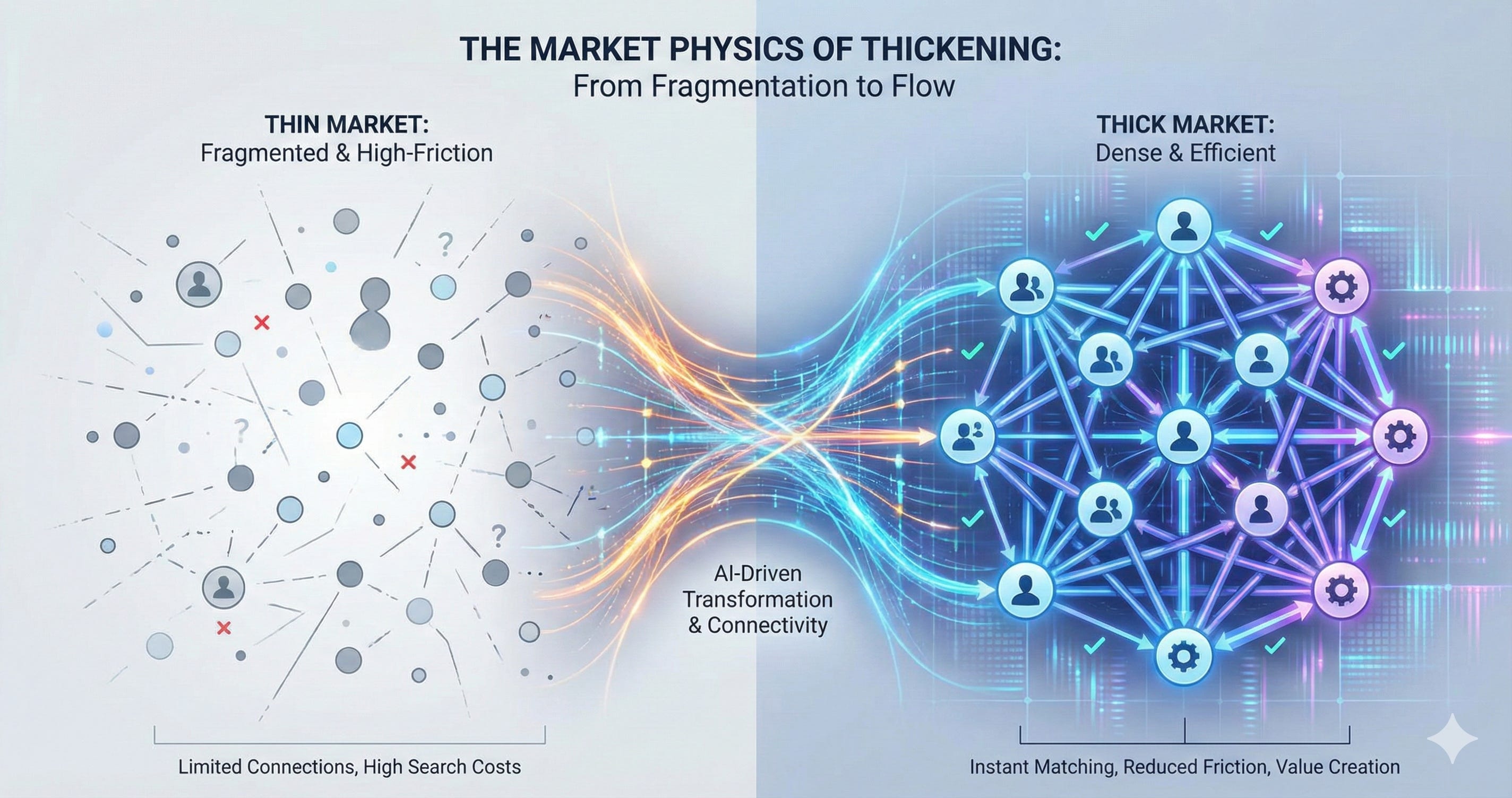
Thousands of valuable markets stay thin — barren, or run by gatekeeping brokers — because the same handful of frictions blocks every deal. Most builders fight those frictions one at a time, alone, reinventing the same wheels in each new market. DeeperPoint takes a different path: it starts from the theory of why markets stay thin.
The DeeperPoint thesis: the frictions that keep markets thin are common across thousands of markets — so the solution can be built once and reused. A market builder adds only their market’s business logic, instead of rediscovering the same problems alone.
Practical entry points — from diagnosing a market’s friction to deploying the open-source engine. For how the engine itself is built, see the architecture.
A rigorous diagnostic tool that cross-tabulates the common thin-market challenges against the AI interventions that neutralize them.
250 prospective thin markets across 12 sectors, each tagged with binding challenges and sponsor opportunities.
A multi-model AI synthesis system that forensically deconstructs the market physics of any company in ~5 minutes.
A developing MIT-licensed headless marketplace engine and curated context manager. Admin dashboard included; participant UI is yours to build.
Most marketplace platforms aim to close deals. DeeperPoint aims to get deals ready to close. The platform’s primary output is a Deal Brief — a structured, non-binding summary of everything two parties have explored and agreed. It captures who the parties are, what they propose to exchange, what remains open, and which professional intermediaries (attorneys, banks, insurers, logistics providers) need to act next.
The Deal Brief is designed for markets where an enforceable contract cannot be written yet — because the product specification is still being defined, because multiple facilitators must be assembled, or because the regulatory pathway requires expert navigation. The platform does the discovery and negotiation work. Your professionals do the contracting.
That boundary is deliberate. The Deal Brief is as far as friction reduction can go while staying generic — the last step common to every market. Everything after it — the contract, the payment rails, the fulfillment terms — varies with each item of exchange and each market, so it belongs to the parties and the sponsor’s vertical logic, not the shared engine.
See how it works — from profiles to Deal Brief →While Cosolvent and CommonContext are open source, testing a thin market requires realistic participants. ClientSynth is our proprietary simulation tool designed to flood a Cosolvent instance with synthetic, agentic buyers and sellers. It allows you to prove the market physics work before risking live participant capital.
Use the catalog as a sourcing scaffold and portfolio-coverage map, and request marketmaps on specific deals to forensically assess thin-market challenges.
Read the Investor's Guide →Standardize cohort vocabulary with the matrix, seed vertical theses from the catalog, and evaluate applicants on a consistent, evidence-based rubric.
Read the Accelerator Guide →Provide member-owned digital infrastructure to protect your industry from outside tech disruption. Deploy confidential clearinghouses to facilitate intra-industry trade and share surplus capacity without exposing trade secrets.
Read the Association Guide →Execute the "Middle Power" pivot by providing Canadian exporters with sovereign, AI-driven market infrastructure. Overcome the extreme friction of international B2B trade by automating regulatory translation and confidential matchmaking.
Read the Trade Policy Guide →